
From the Creator (Allah) we come, and verily to the Creator (Allah) is our return.
It is with a heavy heart that we have come to know of the passing of Al-Hajj Imam Talib Abdur-Rashid. He was not only my Muslim brother, but also a dear friend of many years.
As Muslims who are descendants of enslaved Africans in the United States, Imam Talib was a strong advocate of understanding Islam not solely as a religion but also as a vehicle for social justice—particularly for Muslims who trace their lineage to those enslaved on these shores.
He had served as the Imam of the Mosque of Islamic Brotherhood (MIB), a Sunni house of worship in Harlem, New York, since 1989. The mosque’s congregation was founded in the 1960s by the followers of Al-Hajj Malik Shabazz (Malcolm X). Imam Talib succeeded Shaykh Abdullah Tawfiq, who succeeded Al-Hajj Malik Shabazz, the founder of Muslim Mosque, Inc., which later evolved into what is now known as the Mosque of Islamic Brotherhood.
Imam Talib was born in Greensboro, North Carolina, in 1951 to a Baptist family, and he was raised in the South Bronx during a period of intense racial upheaval in the United States. This environment profoundly shaped his understanding of the social and political realities impacting African-American communities. Although raised in a Baptist household, Imam Talib explained:
“I was heavily influenced by pan-Africanism, by Black nationalism, by the antiwar movement—all of it,” he said. “And then, I became a Muslim at age 20. And it played a great role in my grasp of the social-justice dimension of Islam.”
A tireless champion of the oppressed—both nationally and internationally—Imam Talib never hesitated to speak out against what he perceived to be injustice. From being born during the early rumblings of the civil rights movement to eventually settling in the so-called “liberal” bastion of New York City, Imam Talib deeply understood the message of Al-Hajj Malik Al-Shabazz concerning the myth of regional innocence. He often referenced Malcolm’s statement:
“If you Black, you were born in jail—in the North as well as the South. Stop talking about the South. As long as you south of the Canadian border, you are in the South.”
Imam Talib was a staunch supporter of Imam Jamil Al-Amin and worked diligently for his exoneration. He also embraced and empowered the next generation of Muslims, earning the affectionate nickname “the Hip Hop Imam” for recognizing the immense communicative power of Hip Hop culture. His support and collaboration with artists such as Mos Def and Q-Tip reflected his ability to reach hearts across generations.
In addition, Imam Talib served for many years as a Muslim chaplain at Sing Sing Correctional Facility and was one of the founding members of the Muslim Alliance in North America (MANA), serving on its board of directors until health challenges limited his activity. His work extended to numerous areas, including:
Imam Talib’s work consistently embodied the Qur’anic mandate of enjoining what is right and forbidding what is wrong. His activism, scholarship, and compassion reflected a holistic approach to Islamic leadership—one rooted in service, dignity, and truth.
My most recent image of Imam Talib is a video he posted on Facebook, riding his scooter to go vote—still, even in his later days, urging Muslims to remain politically engaged:
- Amir (leader) of the Harlem Shura, a coalition of seven Harlem mosques
- Counseling Muslims living with AIDS and victims of domestic violence
- Board membership and advisory roles in various interfaith and social institutions, including:
- A Partnership of Faith
- The Bertram Beck Institute on Religion and Poverty
- The Chancellor’s Interfaith Advisory Committee of the New York City Board of Education
- Harlem Congregations for Community Improvement
- The Interfaith Center of New York
- The Temple of Understanding
May َوَﺗَﻌﺎَﻟﻰ ُﺳْﺒَﺤﺎَﻧُﮫ ﷲ (Allah, may He be praised and exalted) grant our beloved brother the highest level of Paradise—Jannatul Firdaus
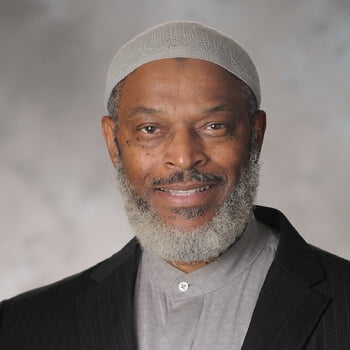
Imam Nadim Sulaiman Ali is originally from Chester, Pennsylvania and has resided in Atlanta, Georgia since 1979. He is the Imam Emeritus of the Community Masjid of Atlanta, the former Convener for the Metro Atlanta Majlis Ash-Shura, a founding member of MANA, and the current MANA Board Secretary. Imam Nadim works as a licensed professional & master addiction counselor and serves Muslims and the general community. Offering counseling services consisting of Pre-Marital, Marital, and Individual counseling. He is a therapist and consultant in Stress Management, Violence Prevention, and Tai Chi. He has authored numerous articles on counseling, and family matters, and he is also the co-founder of the Spoken word acapella Group Dawah Ensemble. He obtained a Bachelor’s degree in Communications from Shippensburg State University, a Master’s degree in counseling psychology from the Georgia School of Professional Psychology, and is a Licensed Professional Counselor and a Master of Addiction Counselor.