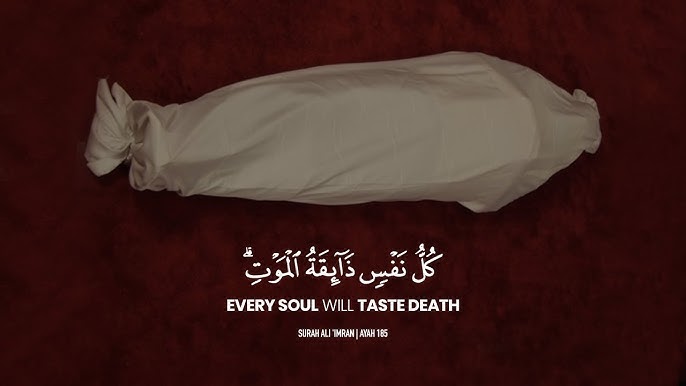
Every soul shall taste death. And you will only be given your [full] compensation on the Day of Resurrection…”
Surah Aal-‘Imran (3:185)
Since my mother’s passing in 2000, I’ve been deeply drawn to exploring the spiritual essence of life, the existence of our souls, and the journey the soul undertakes at the moment of death. Within a year of losing my mother, I faced the heartbreak of becoming a widow. Seventeen years later, I experienced the pain of widowhood once again. Subhanallah!
Death. It has been one of my greatest teachers, and it is the one certainty no one can avoid, the reality that every soul will encounter—regardless of status, age, health, or wealth. And yet, for the believing heart, death is not something to fear, but to reflect upon. In Islam, death is not the end, but a passage—a bridge to the eternal life of the Hereafter. It is a mercy from Allah that death was made visible to us through the passing of others, so that we might awaken from heedlessness and re-center our lives on what truly matters.
A Reminder, Not a Punishment
When we hear of someone returning to Allah—especially someone close, young, or seemingly full of life—it shakes us. This shaking is not cruelty; it is compassion. It is Ar-Rahmān, the Most Merciful, stirring our hearts to remember our purpose.
The Prophet ﷺ said: “Remember often the destroyer of pleasures—death.” (Tirmidhi, Hasan)
To “remember death” in Islam is not to live in fear, but to live with intention. It is a spiritual tool that reminds us to turn back to Allah, to simplify our pursuits, to forgive more easily, and to love more deeply.
The Soul’s Wake-Up Call
Death is like the dawn after a long night. For those who sleep through life, it comes as a surprise. But for the heart that stays awake in remembrance, death becomes a gentle transition, not a terror.
When someone dies, it is as though Allah is whispering to us: “O My servant, are you ready to meet Me?” This is the inner work of the living—to ask ourselves: “If I were to return to Allah tonight, would my soul be at peace with how I’ve lived today?”
What Death Teaches the Living
The illusion of permanence fades. We realize that nothing lasts—not beauty, money, or titles. Only actions remain. Relationships matter most. We remember to reconcile, to love sincerely, and to make du‘ā for one another. Time becomes sacred. We stop delaying repentance, Qur’an recitation, or caring for our health. Healing takes on new meaning. We no longer chase health just for appearance—but to serve, worship, and prepare for our meeting with our Lord.
A Natural Approach to Grieving
From a healing perspective, grief after loss is not a sign of weakness but a natural process through which the heart and soul navigate the pain of separation. Islam does not suppress grief; rather, it honors and dignifies it. I felt this deeply when my mother passed away. At that time, I had been a Muslim for only six years, and this moment became a profound milestone in understanding how Islam had shaped my response to death, especially the loss of someone so beloved. I found strength in the Islamic perspective of death as a spiritual journey—not just for the one who has passed but also for those left behind. My faith encouraged me to respond with clarity and composure rather than despair. I was moved by the dignity Allah instilled within me and humbled to witness how He used this experience to guide my family through the transformative beauty of Islam. Allahu Akbar!
The Prophet ﷺ wept when his son Ibrāhīm died, and he said: “The eyes shed tears and the heart feels sorrow, but we do not say anything except what pleases our Lord.” (Bukhari)
If you are grieving, dear believer, know this:
Take care of your body gently during grief—warm nourishing foods, calming teas (like chamomile or tulsi), and rest help regulate the nervous system.
Support your heart with dhikr: Saying “Yā Hayy, Yā Qayyūm” (O Ever-Living, O Sustainer) brings steadiness to the grieving soul.
Hydrate and breathe deeply. Grief causes constriction. Sip water slowly, and do grounding breaths—inhale for 4, hold for 4, exhale for 6.
Cry in sajdah. Let your grief flow in the most intimate place you can be—prostrated before your Lord.
The Divine Names in Death and Healing
In reflecting on death, two beautiful Names of Allah rise to the surface:
Al-Muhyi (The Giver of Life): He gave us this life as a gift, not a guarantee. Every breath is a trust.
Al-Mumeet (The Taker of Life): He takes life not out of cruelty, but as part of His perfect decree. Nothing is random.
When you remember these Names, you realize: your life is not just passing time. It is an amanah—a trust to be used well before it is returned.
A Du‘ā for the Living Heart
O Allah, make death a relief for us from every evil. (Ahmad, authentic)
And for those of us still walking this earth, let us recite often: O Allah, do not make this world our greatest concern. (Tirmidhi)
In Closing: Live With the End in Mind
Dear believer, let death not be a dark thought we push away, but a sacred guest that helps us live better, love deeper, and turn more often to Allah. The believer remembers death—not to despair, but to prepare. Let it bring clarity, compassion, and courage into your every day.
And remember…
“Blessed is the one who prepares for the Hereafter, before death comes to him suddenly.” – Ibn Qayyim (rahimahullah)
Your life is a garden. What you plant now will be your shade in the grave. So plant sincerity. Plan good deeds. Water your garden with dhikr. And may Allah, Al-Hādī (The Guide), lead you gently Home.
Akanke is a communications specialist and consultant with a degree in Communication from Georgia State University, focused on film, TV, and cultural anthropology. Her career is diverse, and her interests span various creative forms of expression — from producing TV and radio shows to creating documentaries, writing, graphic design, and life coaching, she strives to make a lasting and authentic impact wherever she goes. She reverted to Islam in 1994 and is passionate about Islam and Islamic spirituality, a passion that runs through nearly every corner of her work. Akanke has been a dedicated supporter of the Muslim Alliance in North America (MANA) since 2007, currently serving as the organization’s Board Vice President — working alongside the Board President and Secretary to help shape MANA’s trajectory — and previously served for several years as its Communications Director. A native of Atlanta, she now resides in Dayton, Ohio.