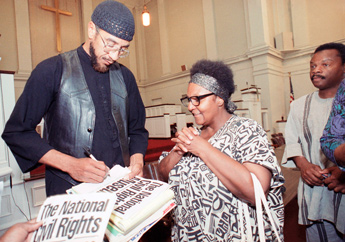
The recent passing of Imam Jamil Al-Amin (formerly known as H. Rap Brown) marks the loss of a towering figure whose life arc spanned from the front lines of the American Civil Rights Movement to global advocacy for the oppressed. He passed away in federal custody after 23 years of imprisonment for a crime he steadfastly maintained he did not commit.
His death is a profound loss and a stark reminder of the grave injustices he endured. It underscores the urgent need for a full and transparent review of his case to posthumously clear his name and recognize his true legacy.
Imam Jamil Al-Amin was a larger-than-life leader who courageously fought for justice and freedom from the streets of the American South to the global stage. His moral clarity and unwavering commitment were instrumental during the 1990s, particularly through his work mobilizing the American Muslim community and allies to confront international crises.
His leadership was deeply embedded within the American Muslim community. As a key member of the National Shurah Council during the 1990s, a body comprising major national Islamic organizations of the time (Islamic Society of North America-ISNA, Islamic Circle of North America, Ministry of Imam Warith Deen Muhammad and his National Community, he played a pivotal role in fostering unity and directing collective action toward critical issues.
A Champion for Bosnia and Kosovo
Imam Jamil’s international human rights work stands as a testament to his principled activism. His efforts on the Bosnia Task Force in the 1990s were crucial in organizing relief, raising global awareness, and applying political pressure to help end the genocide against Bosnian Muslims.
Following this work, and in direct response to the Serbian aggression in Kosovo after the Bosnian genocide, he continued his advocacy. In his work with the Kosovo Task Force. In this capacity, he worked to support the Kosovan struggle for freedom and independence. On behalf of Muslim American leadership, he met with President Ibrahim Rugova of Kosovo, reinforcing solidarity and support for their cause during a critical period of their history.
His legacy is one of universal struggle for human dignity. He encouraged oppressed people everywhere to fight for their freedom, stand up for their rights, and pursue justice. To have seen this giant of an upright human being spend his final years in prison under a wrongful conviction is a travesty. The fight must continue by ensuring his name is cleared and his true story is told.
A Wrongful Conviction and a Call for Justice
In 2002, amid significant procedural and evidentiary irregularities, Imam Jamil was convicted for the murder of a Fulton County Sheriff’s Deputy. The actual perpetrator, federal inmate Otis Jackson, has repeatedly and credibly confessed under oath to committing the crime.
Despite this confession and an ongoing review by the Fulton County District Attorney’s Conviction Integrity Unit, Imam Jamil’s conviction was never vacated. Furthermore, his transfer from state to federal custody is widely believed to have been motivated by the positive influence he had on inmates, many of whom were embracing Islam through his teachings, rather than for legitimate security concerns.
In his final years, Imam Jamil battled cancer, while advocates repeatedly warned the Federal Bureau of Prisons about his deteriorating health and condemned the failure to provide adequate medical care.
Honoring His Life and Work
In honor of Imam Jamil Al-Amin’s life and work, there are clear calls for action:
- The Fulton County District Attorney’s Office to immediately vacate his wrongful conviction, based on the confession of Otis Jackson and the many irregularities in the case.
- The United Nations Human Rights Council and leading international human rights organizations to open an official investigation into the injustices of his trial and imprisonment.
- National and international civil rights organizations to formally recognize the full scope of his life, work, and legacy.
We stand in full support of his family’s efforts to clear his name posthumously. The blood of a martyr is not ordinary; it transfuses itself into the life of a people and energizes them. May Imam Jamil’s lifelong struggle for peace through justice continue to inspire us all.