
African American Muslims from various locations in the US and beyond convened on August 31, 2025, for an online fundraising event in support of the Annual Shaykh Hassan Cissee Ziyara and Commemoration set to take place on December 7th in New York.
The event, hosted by the charismatic Omar Reagan, an African American Muslim entertainer, centered around the theme: “African American Muslims and Islamic Education in Medina Baye, Senegal.” This inspiring gathering featured heartfelt stories and reflections from former students of the African American Islamic Institute (AAII), who shared their transformative experiences of studying the Quran while living in Medina Baye, Senegal. The event honored the enduring legacy of Shaykh Hassan Cissé (1945–2008), a globally acclaimed Islamic scholar, spiritual leader, and humanitarian who founded the institute. Through their narratives, the speakers highlighted the profound impact of Quranic education in Medina Baye, emphasizing how Shaykh Hassan’s steadfast commitment to education, service, and community upliftment continues to inspire students, families, and educators today.
For decades, Medina Baye has served as a spiritual and educational haven for African American Muslims, fostering a profound connection to faith, heritage, and community. Through AAII, students and families from across the United States have been welcomed, receiving not only Quranic education but also a transformative life experience that shapes identities and resonates across generations.
Below is an overview of the intriguing stories that were told by a few of the speakers:
Samiha Rahman: Researching a Legacy of Service and Scholarship
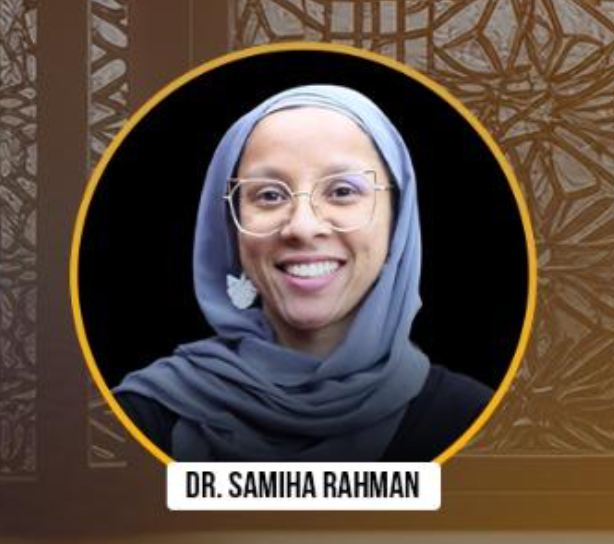
Dr. Samiha Rahman is an Assistant Professor at California State University, Long Beach. She holds a joint Ph.D. in Africana Studies and Education from the University of Pennsylvania. Her scholarship and teaching examine how young people and their families engage race, religion, and education to achieve justice and liberation.1 She opened the program with a moving tribute—weaving together history, scholarship, and personal reflection. She began by recounting the founding of Medina Baye by Shaykh Ibrahim Niasse, the grandfather of Shaykh Hassan, in 1930 as a center for Islamic learning and spiritual refuge from colonial oppression. She then traced the lineage and vision of Shaykh Hassan Cissé, who, as a young boy, answered the call to connect African Muslims with their counterparts in the United States. She described how, inspired by this vision, the African American Islamic Institute (AAII) was established to provide Blackamerican youth with opportunities to study the Quran and Islamic sciences in Senegal. Drawing from her own research and forthcoming book, “Black Muslim Freedom Dreams: Islamic Education, Pan-Africanism, and Collective Care,” which is slated to be published by NYU Press next year, Dr. Samiha emphasized that AAII is not just about memorizing the Quran, but about empowering students to serve their communities and bridge the gap between African and American Muslim experiences. Her story highlighted the transformative power of education, heritage, and the enduring legacy of Shaykh Hassan’s vision.
Hafiz Ahmed Muhammed: His Parents’ Sacrifice, A Family’s Legacy
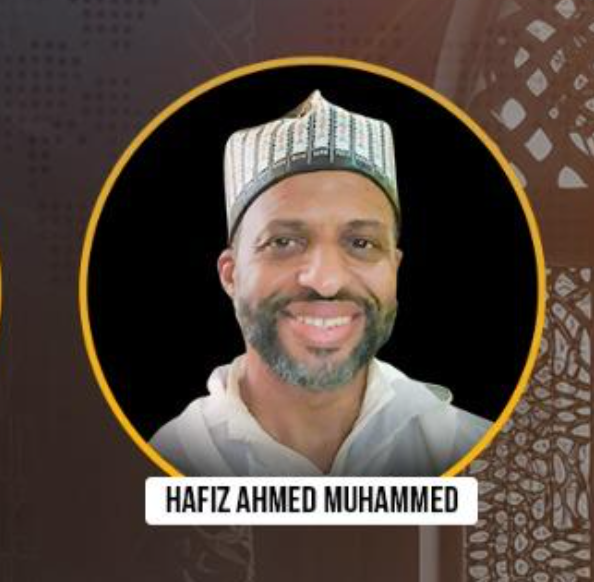
Hafiz Ahmed Muhammed shared a powerful account of his journey as one of the first African American students to study and memorize the Quran at the African American Islamic Institute in Medina Baye. He spoke about the tremendous sacrifice and faith of his parents, who entrusted him and his brother to Shaykh Hassan’s care in Senegal during the 1980s, despite not fully knowing what awaited them. Ahmed described the challenges of adapting to a new culture, the early days of the school when resources were limited, and the perseverance required to succeed. He highlighted the strong support system among students, teachers, and the local community, and credited his experience in Medina Baye with shaping his character, deepening his faith, and providing a foundation for lifelong service and leadership. As he reflected, “My mother didn’t know exactly who Shaykh Hassan was, but she trusted Allah and made the sacrifice to send us to Senegal in the 1980s. Memorizing the Quran was the icing on the cake. My father wanted us to be strong Muslims, and that’s what this experience gave us.”
Kareema Hunter: Parenting with Intention and Trust
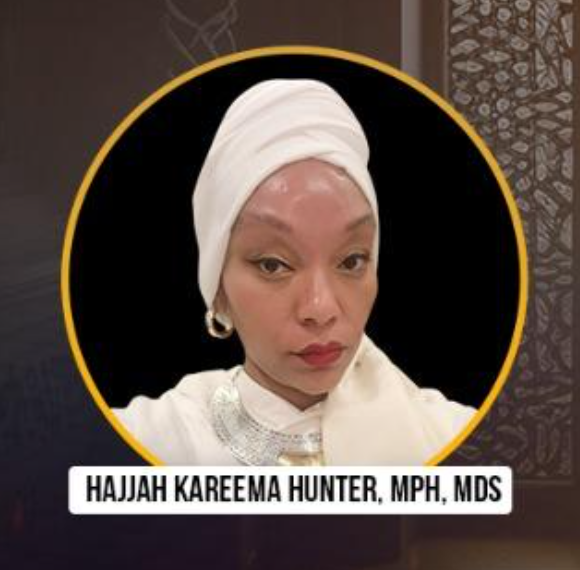
Kareema Hunter shared a deeply personal reflection on her journey as a mother who sent her children to study the Quran in Medina Baye. She described her approach by emphasizing the importance of raising children with intention, trust, and spiritual purpose. Kareema spoke candidly about her initial fears and the difficulty of letting her children go so far from home, saying, “How do I really cover them? How do I cover them in this world and the next, when I’m here and when I’m not?” She drew inspiration from the story of Prophet Ibrahim and his son, highlighting the need for both parents and children to submit to Allah’s will and to nurture steadfastness and independence. Kareema ultimately found that the sacrifices she made were rewarded many times over, as her son, Ahmed, and two of her daughters, Habiba and Asma, grew into confident, compassionate Muslims grounded in their faith with knowledge of the Qur’an as their undergirding foundation. As she reflected, “There is no greater gift from Allah than to know the Quran and to teach it… What you get in return is far greater.”
Sayyida Kubra: A Life Shaped by Service and Learning
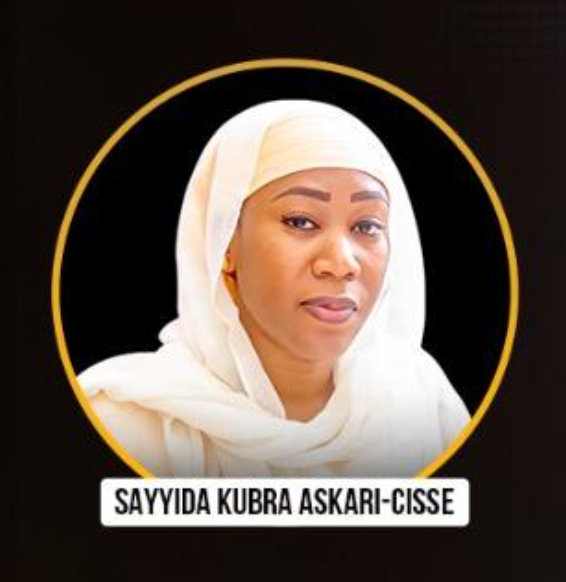
Sayyida Kubra’s journey to Medina Baye began long before she set foot in Senegal. Raised in a family that instilled a love for Africa and Islam, Kubra was taught by her parents and aunt that her roots and responsibilities extended beyond American soil. At 13, she moved to Medina Baye, entering a world where learning was inseparable from service. Living in Shaykh Hassan’s house, Kubra was immersed in an environment where the Quran was not just recited, but lived. She recalls, “We learned the value of loving the Quran, loving the Prophet, and being of service. Even as young people, we were always called to help, to be on task, to be part of the work.”
Her journey was not without challenges. At one point, seeking more focus for her Quranic memorization, she moved to Kossi Atlanta, a farming village about 45 minutes from Kaolack2, only to find that leadership and responsibility followed her there. “I was running the house, organizing meals, supporting other students. In retrospect, I see that I was being prepared for the path I’m on now.”
Today, Sayyida Kubra’s personal family includes her husband, Shaykh Mahy Cisse, spiritual leader of the Tijani tariqa, and their daughter, Umm Sulaiman Cisse. Together, they live in Medina Baye, where both she and her husband—whose international travels require him to be away often—are deeply involved in educational and community initiatives. She mentors new students, runs the AAII preschool with over 200 children, and continues to support the Institute’s humanitarian and educational mission. “This work is not just mine,” she says. “It’s the legacy of Shaykh Hassan, and I’m grateful to be a part of it.”
Mohamed Ali: From Searching to Centered
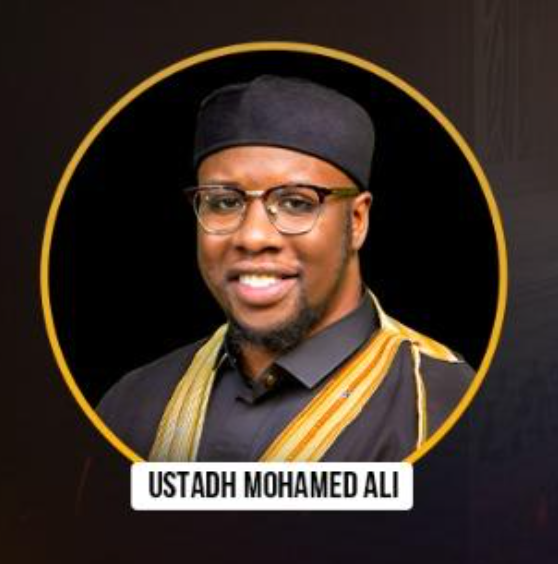
Mohamed Ali’s story is one of spiritual searching, resistance, and ultimately, transformation. Raised in Brooklyn, his family’s religious journey took them from Islam to Buddhism to Christianity and back to Islam. At 13, his mother suggested he take a year off from college at Howard University to study in Senegal. He agreed only after being promised a car and help with tuition upon his return.
His first months in Medina Baye were difficult. “I hated it—the heat, the flies, the unfamiliarity. I wasn’t practicing Islam at all,” he admits. But as time passed, stripped of distractions and surrounded by a community focused on faith and learning, Mohamed began to change. “Everything was stripped down to what mattered: community, food, God, shelter.” Inspired by the example of Shaykh Mahy Cissé—a man whose humility, generosity, and deep faith left a lasting impression—Mohamed found himself drawn to the very tradition he once resisted. He immersed himself in Quranic and Arabic studies, eventually earning a Bachelor of Arts degree in Arabic literature and Islamic sciences. “Watching Shaykh Mahi, I realized this is what it means to be a Muslim. That’s who I want to be.”
Mohamed Ali spent 12 years studying in Medina Baye—completing primary, secondary, and high school programs at the African American Islamic Institute. He graduated in June 2024 and returned to the United States in December. Today, he lives in Atlanta with his wife and daughter, where he is dedicated to serving his community and continuing the work inspired by his hard-earned scholarship, education, and experiences in Medina Baye.
Ishaq and Kori Majeed: Parenting with Trust and Vision
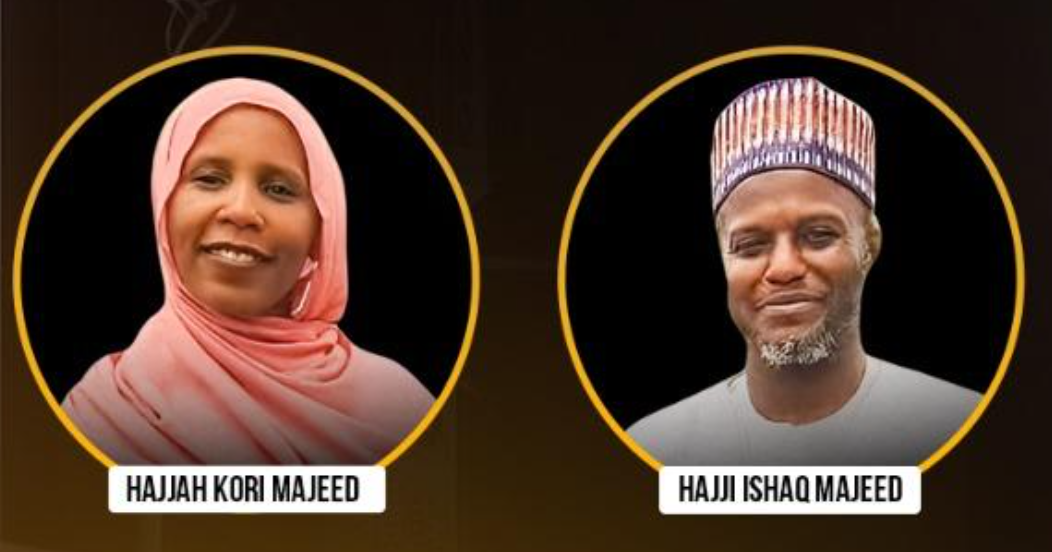
For Ishaq and Kori Majeed, the decision to send their daughters to study in Medina Baye was both a leap of faith and an act of love. At the time, Ishaq was a cybersecurity IT professional who had known many of the early students who traveled to Africa. Ishaq had known Sayyida Kubra’s family since his childhood in Atlanta, where her mother, Dr. Khadijah Askari, had been one of his first teachers. When he met with Shaykh Mahy in December 2014 in New York and learned he was married to Sayyida Kubra, he knew he wanted his daughters to learn the Quran in the Medina Baye environment. Kori, a Maryland Master Naturalist, author, and community leader, was initially hesitant. The thought of sending her children so far away was daunting. But after visiting Medina Baye and witnessing the warmth, discipline, and spiritual focus of the community—especially the nurturing presence of Sayyida Kubra—her heart was put at ease.
The Majeeds decided to send their eldest daughter, Sanaa, for what was intended to be a year as part of their homeschooling journey. Ishaq recalls the difficulty of leaving his daughter: “It was one of the hardest things I could do. We both cried. But I reminded myself—and her—that we were leaving her with Allah and the people of Allah.” Kori describes the transition from being a hands-on mother to becoming more of a guide and supporter, relying on the power of dua and the strength of the community in Senegal. Their daughters not only learned the Quran, but also absorbed the confidence, character, and cultural richness of their Senegalese peers and the adults that surrounded them. “They came back with a spirit and presence that stays with them,” Ishaq reflects. “We’re not worried about how they’ll carry themselves—they have a foundation for life.”
Imam Kafani Ibrahim Hassan Cisse: A Journey Foretold
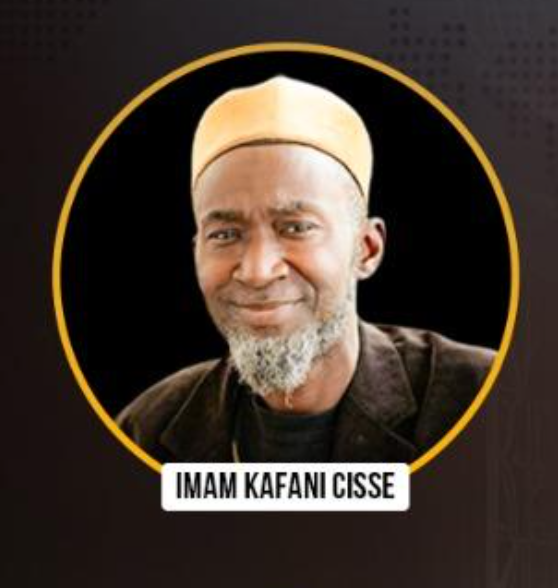
Imam Kafani Ibrahim Hassan Cisse’s journey to Medina Baye is a testament to faith, destiny, and transformation. Raised in a Christian (Lutheran/Baptist) household, Kafani embraced Islam as a young adult and was already a world-traveling performer when he received an invitation to study in Senegal. Remarkably, as a young boy, his mother had foretold that he would one day go to Africa. While in his third year of college, he traveled to Medina Baye, initially intending only a short visit. He was hesitant to stay, but after a powerful dream about his father and encouragement from respected community leaders, he decided to remain and immerse himself in the rigorous spiritual and academic life of the Institute. The journey was not easy—he faced cultural adjustments and the challenges of dedicated Quranic study—but he persevered, drawing strength from the legacy of the Tijani scholars before him. Today, he looks back with gratitude for the struggles and the blessings, proud to be part of a community and tradition that shaped his faith and service.
Imam Kafani spoke full-heartedly about Shaykh Hassan. With deep reverence, he described him as “the five-foot giant, the one who whispered, and there was a rumble, the one who, when he recited the Quran, you would sigh.” He expressed immense gratitude for the blessing of knowing Shaykh Hassan and being part of his legacy, highlighting the profound spiritual impact and inspiration Shaykh Hassan provided to all who encountered him.
Shaykh Munir Cisse: Continuing the Legacy
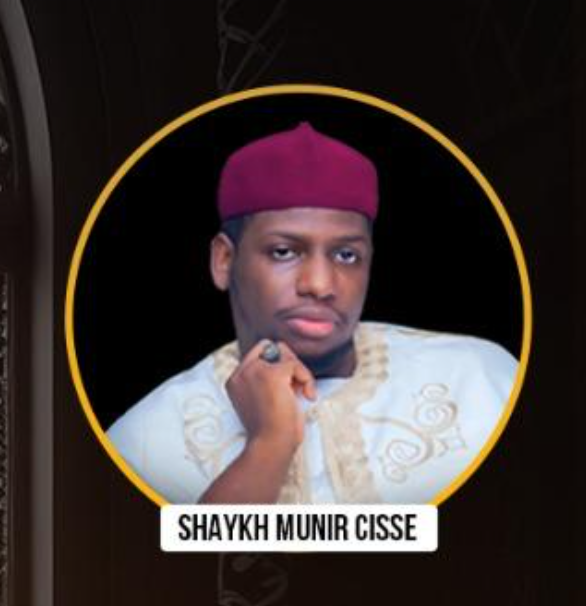
To conclude the event, Shaykh Munir Cisse, the son of Shaykh Hassan, was welcomed. He introduced the AAII Online initiative as a continuation of his father’s legacy, saying: “It is my honor to introduce our AAII online courses created to serve this work… This initiative is not new, nor is it an invention. It’s a continuation of the path before us, with the blessing and approval of our elders. These courses bring learning directly to you, allowing us all to deepen our understanding, strengthen our faith, and walk more firmly in the way of Allah. We humbly invite you to join us as students, supporters, and partners, so that this effort may serve our community well.” He also said, “We ask for your prayers and support as we work together to preserve and carry forward the noble legacy of Imam Hassan.”
Fundraising and the Path Forward
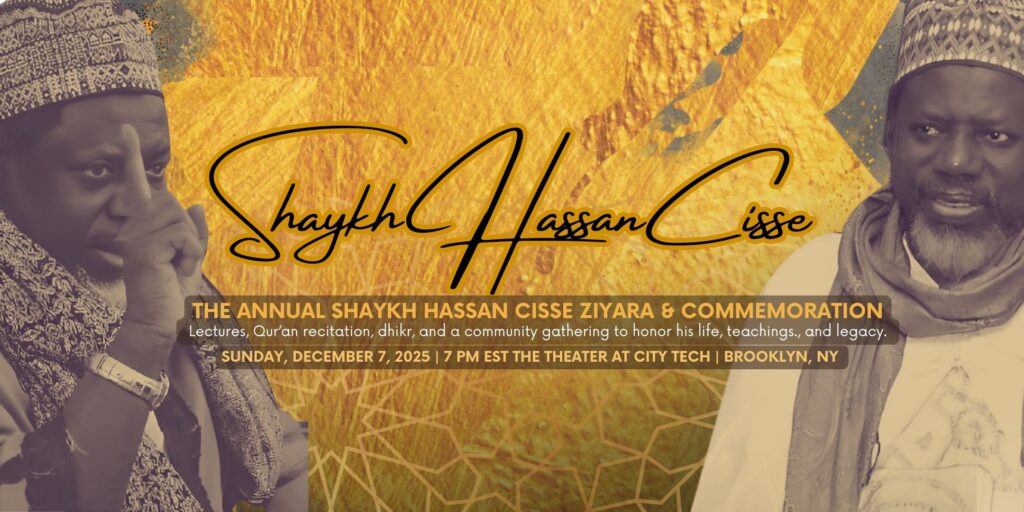
During the event, Omar Regan actively encouraged attendees to contribute donations, fostering a strong sense of community, shared purpose and collective responsibility. A total of approximately $3,000 was raised, which will go toward hosting the Annual Shaykh Hassan Cisse Ziyara and Commemoration. This year’s gathering is scheduled to take place at The Theater at City Tech in Brooklyn. However, additional contributions are still needed to meet the budget requirements. To support the cause, donors can choose from the following options:
- Credit/Debit: https://tinyurl.com/DonateIslamicEdSenegal
- PayPal & Zelle: mailto:info@nightforthebeloved.com
- Apple Pay: (929) 375-7665
Register to attend the annual ziyara. It’s free to the public.
Watch the replay of the fundraiser.
- https://www.csulb.edu/college-of-liberal-arts/human-development/page/samiha-rahman ↩︎
- https://amuslimconvertoncemore.blogspot.com/2015/02/the-redemption-of-sidi-ibrahim-dimson.html ↩︎

Akanke is a native of Atlanta who now resides in Dayton, Ohio. She reverted to Islam in 1994 and is passionate about Islam and Islamic spirituality. Akanke is a graduate of Georgia State University, where she earned a degree in Communication, with a focus on film, TV, and cultural anthropology. Her career is diverse, and her interests span various creative forms of expression. From producing TV and radio shows to creating documentaries, writing, graphic design, and life coaching, she strives to make a lasting and authentic impact wherever she goes. Akanke has been a dedicated supporter of MANA since 2007, currently serving as the organization’s Board Vice President. In this role, she plays a key part in working with the Board President and Secretary to shape the organization’s trajectory. Additionally, she serves as MANA’s part-time Communications Director.