
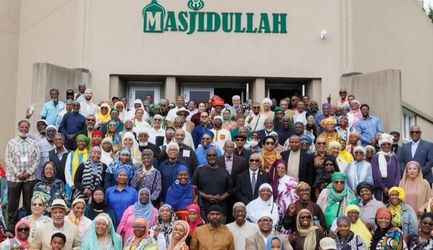
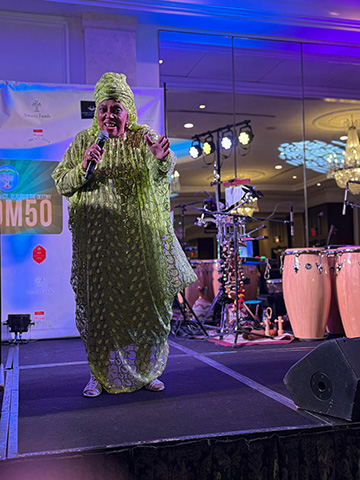
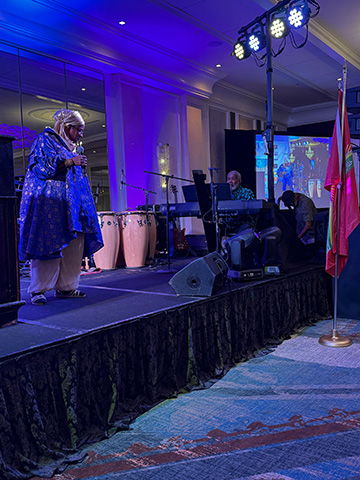
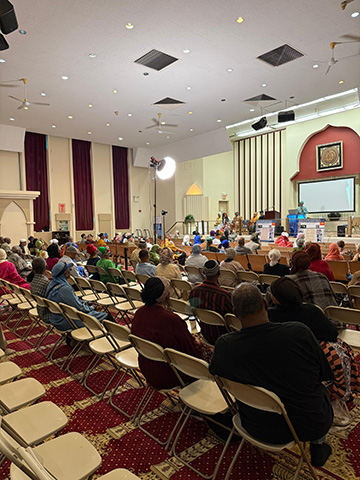
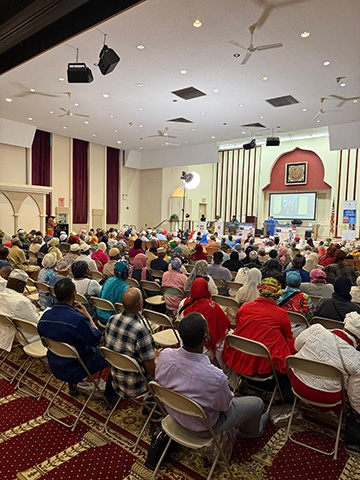
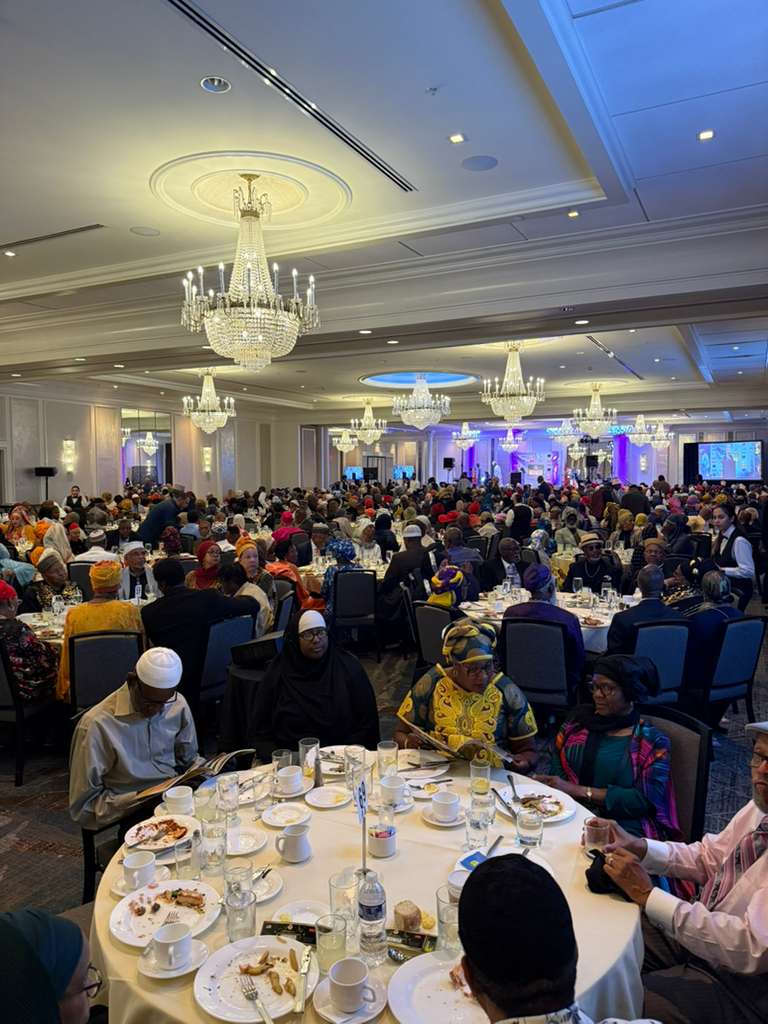
The moment that stays with me most is seeing 750 people dressed in their finest. It was seeing the elders and the youth together. I saw a stage come alive with musicians who found Islam through their craft. Saxophones. Guitars. Drums. Men and women singing with beautiful voices. I know some communities disagree on the permissibility of music. I also know what I felt at this anniversary. I know the power of promoting the message of Islam through music. I have been doing that for twenty-five years with Native Deen. But to sit in the audience and watch master musicians do it at such a high level was a true gift. What made this anniversary complete was having both of my sons with me. One drove up from Baltimore, and the other drove down from Connecticut. Sharing that memory with them is something I will carry for a long time.
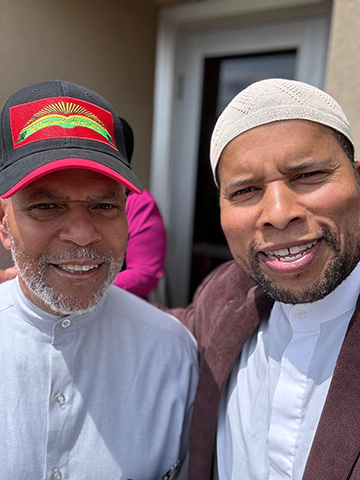
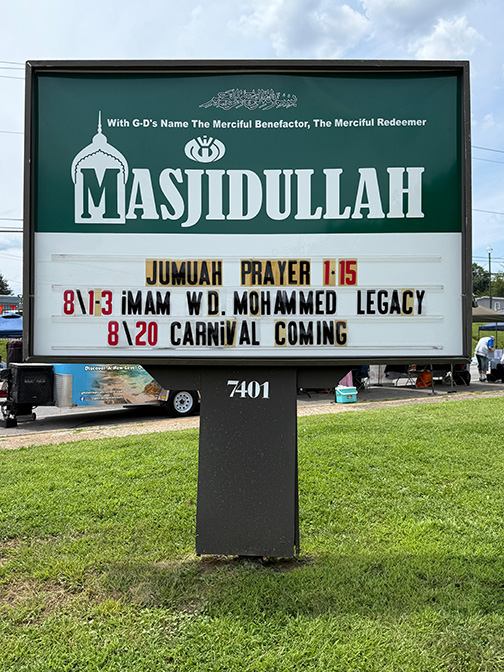
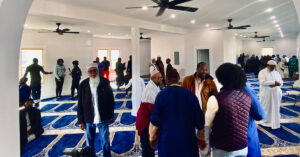
I came to Philadelphia to represent MANA at the 50th anniversary of the ministry of Imam W. D. Muhammad. This event was more than a commemoration. It was a living archive. I saw faces from my own timeline as well as faces from the broader history of the community. I reconnected with Fitrah Muhammad and Ayesha K. Mustafa of the Muslim Journal. I spent time with Aneesah Diwan, a scholar of Qur’anic Arabic and a powerful speaker. I greeted Dr. Bashir Ali and Imam Saafir Rabb, who once served as the executive assistant to Imam Muhammad. I hugged Rudolph Muhammad, my martial arts instructor since I was six years old in Kansas City, Missouri. My Uncle Frankie and Aunt Angela were there too. It felt like old and new threads weaving together into one cloth.
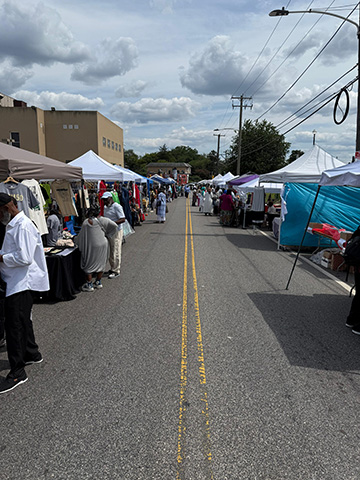
Philadelphia stepped into the celebration, too. A city that is somewhere between ten and twenty percent Muslim. The street was blocked off and lined with more than twenty-five booths. Food, drinks, clothes, books, oils, and more. I love biryani and I love kebab, but there is a different kind of joy when you taste the food of our people. It feeds the soul and the stomach at the same time. The whole scene felt like the neighborhood was lifting up and honoring this community.
Inside the sessions, I took notes as fast as I could. I was reminded of how this community claimed its own language. The term “Bilalian” was developed by Imam W. D. Muhammad as a clear statement that we are not Arab and that Islam is not an ethnic identity. The term honors Bilal, a former slave who became one of the most honored companions of the Prophet. Bilal was chosen to call people to the faith through his voice. These descriptions helped me see the wisdom in using the term Bilalian to describe descendants of enslaved Africans in America. We are still not in agreement on what to call ourselves. We have shifted from the “N” word, to colored, to Negro, to Afro American, to African American, to Black, and the journey continues as new terms emerge that cause discomfort for some and do not quite fit for others. I was reminded to be careful about letting others name us. “Black Muslims” was not a term the Honorable Elijah Muhammad created. It became popular through C. Eric Lincoln’s book, a Duke University Professor at the time. Names can shape people’s perception of you. Communities should speak for themselves and name themselves. If we do not tell our story, someone else will. If we do not define ourselves, someone else will.
At this anniversary, I learned about monumental changes, challenges, and shifts within the W. D. Muhammad community. In 1977, within two years of assuming leadership, Imam W. D. Muhammad led what was then the largest American delegation to Hajj. He moved the community’s fasting from the month of December to the month of Ramadan. This move re-rooted his community to the rhythm of the Qur’an and helped break the calendar tie with Christmas. Several speakers also spoke transparently about different trials he experienced. I did not know about the overwhelming pressure Imam Muhammad faced externally and internally. There was pressure from the U.S. government, including a $13.5 million lawsuit that forced his community into bankruptcy and to liquidate their properties. There was also internal conflict with some imams not respecting the transition of power and not wanting to follow Imam Muhammad’s leadership.
Through all of this, he never had the demeanor of someone defeated. He was a resilient, patient strategist who was constantly thinking about how to move a nation of people to Al-Islam. A unique nation of people with particular circumstances, a specific culture, and specific sensitivities. Not everyone could see his vision. Not everyone was willing to wait for the community to develop. I wish more people respected his leadership. I wish more people supported his efforts. I wish more people had the patience for his plan. He may have started with the largest pilgrimage to Mecca and realigning the month of fasting with Ramadan, but eventually, he was sending droves of young students to Syria to learn Arabic and Islamic studies. You may or may not know them, but those seeds Imam Muhammad planted are some of the best teachers of Qur’an and Arabic to this day.
There was a call to ratify leadership. How do we verify our leaders and our key organizers, especially in a country with a long history of infiltrating Black and or Muslim organizations to ensure their slow demise? This message resonated with me because I believe we urgently need a better system of holding leadership accountable. Not the hostile type of accountability where social-media accounts cancel leaders with no due process. Nor am I arguing for spiritual bypassing either. We need an established system between those extremes. If we do not build it, we leave space for enemies to manipulate rumors and miscommunication. Our context is not the same as past centuries. We need the courage to think with the tools of our tradition and the reality of our moment. Aneesah Diwan read a passage about government and order that stayed with me, a reminder that we are designed to govern ourselves, our homes, our communities, and our society. It was a call to purify our hearts and step into public service. They said chaos is unnatural and often artificially created, whereas order is how Allah created nature.
I also learned about a concept Imam W. D. Muhammad used often: a new creation. Four hundred years of slavery and institutional racism scarred almost everything about us, and at the same time, it created a people with an intense sensitivity to freedom, justice, and equality. There is a way to read our journey as preparation. Surely with hardship there is ease!!! We are now uniquely positioned to help ourselves, to help America, and to help the world. To remake the world. That is how the Imam would put it. It is as if every word he said was the result of deep reflection. Even in his translation of the Basmallah. Instead of the popular “Most Gracious, Most Merciful,” he would say, “the Merciful Benefactor, the Merciful Redeemer.” When I looked these terms up with what I know now, I could see the strategic use of those words for the spiritual development of his community, and the repetition of “merciful” being closer to the Arabic.
This event was a homecoming and a classroom at the same time. It reminded me why MANA must study this community’s successes and its challenges if we hope to move our mission forward. We cannot build wisely if we do not know our own American Muslim history. If we ignore it, we are likely to repeat mistakes that were already paid for. If we do not know our history, we are doomed to repeat it.
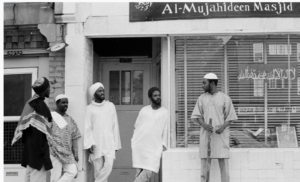
Call to action from MANA: find elder members from the W.D. Muhammad community and learn their history. Learn the context in which all their decisions were made. Resist any rush to judgment, for it will inhibit your ability to absorb much-needed knowledge. Learn the level of commitment and discipline it took for Black Muslims to establish Islam in America in an extremely racist environment. Sit with them, record their stories, and map how their lessons can guide our work now. May Allah make us worthy students of this legacy and let us carry it forward with honesty and humility.






2 Responses
Brother Joshua, Alaikum As Salaam.
Al Hamdulillahi Rabbil Al-‘Alameen!
Thank you very much for this beautiful report on the 50th Anniversary celebration of the leadership of Imam W Deen Mohammed.
Very much appreciated!
From Michael Saahir in Indianapolis, IN
As Salaam Alaikum Bro. Joshua. Thank you. We are pleased to know that some of the “inside” stories are now part of the public discussions; a lot of heavy lifting that many did not know. Yet Allah was/is merciful; He led us out of darkness into the light and the guide he gave us from among ourselves was W Deen Mohammed, who helped his father’s followers to move into the proper religion of Al Islam and shed the “total blackness” of our existence; for that we are grateful to Allah for IWDM, who left us with the message before his passing (he was not even near death) to make for him “a good future.” He wanted us to continue with the best thereof inspired by him and clarified for our understanding based on our unique history coming from a people once enslaved. That is what made the NOI unique – it was not for everybody; it was for the descendants of an enslaved people. So “Bilal” was a rallying personality to keep us moving toward the light. And now we grow our own “NEW AFRICA.”