
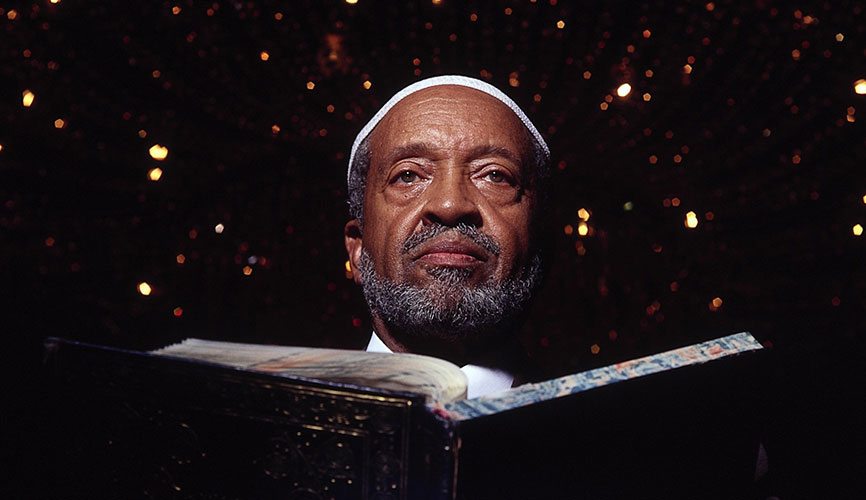
As we celebrate Black History Month, we also commemorate the 50th anniversary of Imam Warith D. Mohammed’s leadership. This milestone allows us to reflect on a significant period that has greatly influenced the lives of many Muslims in America and around the world. After the passing of his father, the Honorable Elijah Muhammad, in 1975, Imam Mohammed assumed leadership of The Nation of Islam.
Imam Mohammed’s leadership heralded a significant transition for many who were formerly associated with the Nation of Islam. With a commitment to Sunni Islam, he guided thousands toward a more inclusive and universal understanding of the faith, rooted in the principles of the Quran and the teachings of the Prophet Muhammad (peace be upon him). This shift was not merely a change in affiliation; it represented a profound evolution in spiritual identity, community engagement, and social responsibility.
Under Imam Mohammed’s guidance, the community embraced a message of unity, compassion, and service. He emphasized the importance of education, encouraging his followers to seek knowledge in all its forms, both religious and secular. This focus on enlightenment helped to bridge gaps within the community and fostered a spirit of cooperation and collaboration among diverse groups of Muslims.
Imam Mohammed’s legacy is also defined by his emphasis on social justice, economic empowerment, and community development. He inspired many to take active roles in their communities, advocating for social reforms and the upliftment of marginalized populations. His teachings encouraged a holistic approach to life that integrated spiritual practice with active participation in societal improvement.
As we commemorate this milestone, we honor Imam Warith D. Mohammed’s unwavering commitment to fostering a community centered on faith, understanding, and mutual respect. His leadership has laid the groundwork for future generations of Muslims, instilling a sense of purpose and direction that continues to resonate today.
In celebrating this 50-year journey, we invite all to reflect on the profound impact of Imam W. D. Mohammed’s teachings and the ongoing evolution of our community. Let us carry forward his legacy of unity, compassion, and commitment to holistic wellness, ensuring that we continue to uplift ourselves and future generations.
May the spirit of Imam W. D. Mohammed inspire us to create positive change, deepen our faith, strengthen our communities, and work toward a just and equitable society for all.

Akanke is a native of Atlanta who now resides in Dayton, Ohio. She reverted to Islam in 1994 and is passionate about Islam and Islamic spirituality. Akanke is a graduate of Georgia State University, where she earned a degree in Communication, with a focus on film, TV, and cultural anthropology. Her career is diverse, and her interests span various creative forms of expression. From producing TV and radio shows to creating documentaries, writing, graphic design, and life coaching, she strives to make a lasting and authentic impact wherever she goes. Akanke has been a dedicated supporter of MANA since 2007, currently serving as the organization’s Board Vice President. In this role, she plays a key part in working with the Board President and Secretary to shape the organization’s trajectory. Additionally, she serves as MANA’s part-time Communications Director.




8 Responses
As Salaam Alaikum Sister Akanke Rasheed. Thank you very much. I deeply appreciate you uplifting the observation of 50 years of Imam Warith Deen Mohammed’s leadership, as well as the foundational work of his father, the Honorable Elijah Muhammad.
As Salaam Alaikum Sister Akanke Rasheed. Thank you very much. I deeply appreciate you uplifting the observation of 50 years of Imam Warith Deen Mohammed’s leadership, as well as the foundational work of his father, the Honorable Elijah Muhammad.
Walaikum as salaam wa rahmatullahi wa barakatu and alhamdulillah, Imam Saahir. Their legacy is vital!
I’m watching and listening to this 50 years later, and I can understand it better, and it still moves me to the core of my being.
Alhamdulillah!
As salaam alaikum my dear sister. I am surprised and pleased upon googling this event to find your presence and contribution to this amazing and significant celebration. May Allah make it an outstanding celebration
Walaikum as salaam wa rahmatullahi wa barakatu dear Maryum and alhamdulillah!
Shaikh Arafat (Digitalimam@msn.com)
Imam Warith Deen Mohammed (W.D. Mohammed) was a pivotal figure in the history of Islam in America, known for leading the transformation of the Nation of Islam (NOI) towards mainstream, traditional Sunni Islam.
His extensive teachings and reforms focused on a universal, authentic understanding of Islam, American patriotism, and community development.
Here are some of the key teachings and concepts emphasized by Imam W.D. Mohammed:
1. Return to Orthodox Islam (Al-Islam)
• Correction of Theology: He rejected the distinct theological beliefs of the original NOI, including the divinity of W.D. Fard and the prophethood of Elijah Muhammad, and the doctrine that white people were “devils.”
• Emphasis on the Qur’an and Sunnah: He guided his followers toward the Qur’an (the holy book of Islam) and the Sunnah (the example and practices of the Prophet Muhammad, peace be upon him) as the supreme religious authorities.
• The Five Pillars of Islam: He introduced and stressed the orthodox practice of the Five Pillars of Islam (declaration of faith, prayer, charity, fasting, and pilgrimage).
2. Universal Human Identity and Brotherhood
• Rejection of Racial Separation: He moved the community away from black nationalism and a race-based theology toward a universal human family concept, stressing that Islam transcends race.
• The Unity of the Human Family: He emphasized the common origin of humanity, stating, “God made you from one single human pattern,” promoting a global vision for the Muslim community (Ummah).
• Interfaith Cooperation: He traveled widely promoting cooperation for the common good of all, working with leaders of different religious traditions.
3. Islam and American Life
• Islamic Citizenship: He taught that Islam is compatible with democracy and encouraged Muslims to embrace their identity as American citizens.
* Civic Engagement: He called for active participation in American life, including voting and engaging in political processes.
• Patriotism: He encouraged his followers to see their future in the country, saying, “I am inviting you to come to my meaning of Patriotism and walk these streets and know that they belong to you as much as they belong to any man.”
4. Community and Social Development
• Moral Excellence and Family: He continually stressed the importance of moral behavior, strong family life, and education as the community’s number one priority.
• Economic Empowerment: He championed do-for-self ownership and collective economics to provide stability and build self-sustaining model communities.
• Equality for Women: He championed the cause of women, dismantling previous segregated classes, supporting their equality based on the Qur’an, and bringing them into leadership positions.
5. Spiritual and Intellectual Freedom
• Liberating the Intellect: He taught that freedom is achieved through the intellect, urging people to move toward “A greater vision, a greater purpose, to a greater responsibility.”
• The Uswah (Excellence of the Prophet): He placed heavy emphasis on studying the uswah (perfect character and excellence) of Prophet Muhammad as the attainable human model for all.
• Evolution of Thought: He saw his teachings as a new “School of Thinking,” encouraging the community to interpret the Qur’an and apply Islamic principles to the new circumstances of modern life in America and the world.
Imam W.D. Mohammed’s legacy is defined by this transformative work, which brought hundreds of thousands of African Americans into mainstream Islamic practice and helped establish the Muslim American identity as an integral part of the global Muslim community. Was that all, not even close. Every Muslim in this country needs to paid homage.