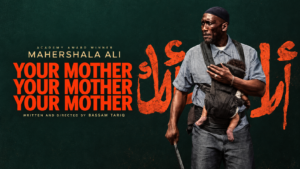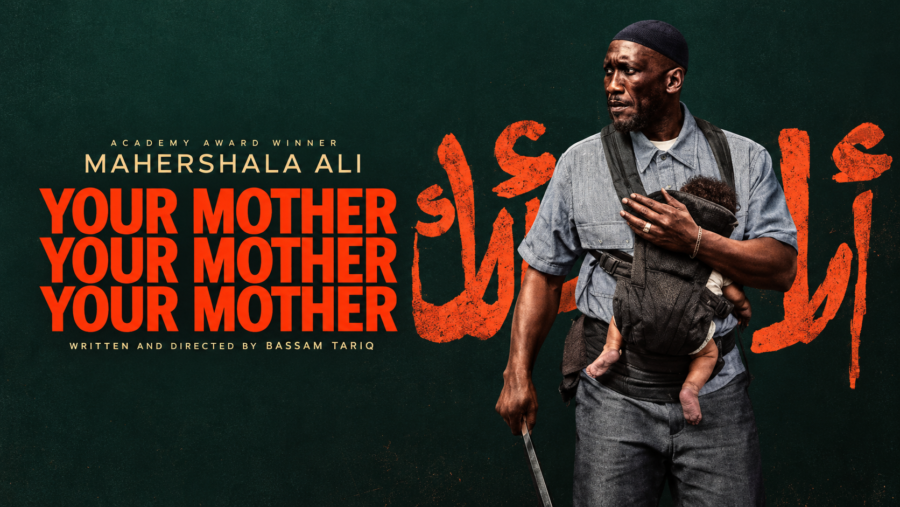
My wife and I were blessed to attend a screening of Your Mother, Your Mother, Your Mother, followed by a discussion with the director, Bassam Tariq. Honestly, I really didn’t know what I was going to see.
I know the director, so I expected a good story and a good film. I got that. But I got something much more emotionally complex than I expected.
This was an action-packed film, but it was also emotionally heavy. There were layers around faith, family, motherhood, violence, sexuality, trauma, morality, redemption, and the contradictions that exist inside human beings.
And it touched me emotionally in ways I did not expect.
The characters were not simple. They were complex human beings with contradictions. The hero’s Muslim faith was a major part of who he was, but this wasn’t simply a “Muslim story.” It was a human story about a Muslim man wrestling with his faith, his morality, his profession, his relationships, and the consequences of the world he inhabited.
I thought it was powerful. I thought it was thought-provoking. And I thought it was a wonderful piece of art.
I can also understand how this movie could be triggering. It deals with some very difficult subject matter. It can force you to confront uncomfortable ideas, emotions, and perhaps even things within yourself.
Since seeing it, I’ve also seen some pretty visceral critiques of the film. And rather than argue about whether somebody should or should not like the movie, I think there is a larger teachable moment here about culture, storytelling, and how we engage artistic expression.
As Muslims, nobody hears the hadith of the man who killed 100 people and asks:
“Why are Muslims telling stories about murderers?”
We understand that the story is about repentance and Allah’s mercy.
So why do we sometimes lose that ability to read a story when the medium changes from a hadith we hear in the masjid to art we see on a movie screen?
Most of us know the hadith.
A man had killed 99 people. He wanted to know whether there could be repentance for him. He asked a worshipper, who told him no. So he killed him too.
Now he had killed 100 people.
Eventually he found a person of knowledge who told him that nothing stood between him and repentance. But he needed to leave the environment he was in and travel toward a community of righteous people.
So he went.
He died on the journey.
And Allah forgave him.
Think about that as a story.
The central character is a murderer.
There is violence. There is death. There is moral failure. There is bad religious counsel. There is good religious counsel. There is a journey. There is transformation. There is repentance. There is death. And ultimately there is Allah’s mercy.
We have taught that story for generations.
Nobody thinks that telling the story endorses murder.
We understand the message.
But when those same kinds of complicated moral questions appear through modern artistic expression, sometimes we suddenly lose our ability to read the story.
And there is another layer of the film that I actually appreciated: the assassin story itself.
I liked that the film drew from the style and emotional weight of the samurai film: the tragic warrior, the disciplined killer, the man operating within a code who is nevertheless forced to confront the morality of what he does.
But even the assassin is not foreign to Muslim history or storytelling.
If you study medieval Islamic history and literature, there is a rich history surrounding Muslim political assassins, secret societies, political intrigue, competing factions, rulers, questions of loyalty, and people who believed they were acting according to a higher cause or order.
In fact, the English word “assassin” is historically associated with the Arabic term “Hashshashin,” a name applied to the medieval Nizari Ismailis, who became famous, and in many cases legendary, for targeted political assassinations amid the political and religious conflicts of their time.
The history and the legends eventually became intertwined. But that is part of the point: these stories have existed within and around Muslim civilization for centuries.
We even have an enormously successful modern video-game and film franchise, Assassin’s Creed, that draws directly from that history and mythology.
And we understand the genre when somebody else is the protagonist.
We understand the tragic warrior in a samurai film.
We understand Rambo.
We understand John Wick.
We understand The Godfather and generations of Italian-American gangster films.
We watch characters kill person after person and still understand that the existence of violence in the story does not necessarily mean that the storyteller is giving us a moral instruction to go and do likewise.
We understand the antihero.
We understand the conflicted warrior.
We understand the man with a violent profession who nevertheless operates according to a code.
We understand the character who has done terrible things and is suddenly forced to confront his own humanity.
So I think we should ask ourselves: Why does our ability to understand those artistic conventions sometimes change when the protagonist is Muslim, his faith is visible, and he looks more like us?
Why can John Wick be a complicated character, but a Muslim protagonist has to become a religious role model?
Why can a samurai be violent and spiritually conflicted, but a Muslim character cannot wrestle with those same contradictions without us assuming that his behavior is being presented as Islamically correct?
Why can we watch gangster films about Catholic characters surrounded by murder, sexuality, family, religion, loyalty, and betrayal without concluding that the movie is teaching Catholicism, but when Islam is part of the moral vocabulary of a complicated character, suddenly every action has to pass the test of a khutbah?
That, to me, is part of learning how to read art.
Again, when those same kinds of complicated moral questions appear through modern artistic expression, sometimes why do we suddenly lose our ability to read the story?
Culture requires artistic expression.
If we want Muslim filmmakers, Muslim novelists, Muslim playwrights, Muslim poets, Muslim musicians, and Muslim storytellers, then we also have to develop a Muslim audience sophisticated enough to engage art.
Art does not always tell you what to think.
Sometimes it puts a human being in front of you and makes you wrestle with what you are seeing.
Sometimes the protagonist is wrong.
Sometimes the protagonist is sinful.
Sometimes the protagonist is struggling.
Sometimes you are supposed to be uncomfortable.
And sometimes the moral lesson is found precisely in the tension between who that person is and who that person could become.
That is very different from a khutbah or religious sermon.
A khutbah can tell you, “This is right. This is wrong. Fear Allah. Do this. Avoid that.”
A story can show you a man standing between right and wrong and allow you to experience the struggle.
Those are two different forms of communication.
And both can teach.
This becomes even more important when we are dealing with difficult subjects like violence, pornography, sexual exploitation, trafficking, addiction, and other realities of modern life.
These things exist.
Our children know they exist.
Our young adults are dealing with them.
Having served as an undergraduate Muslim chaplain, I can tell you that pornography and sexuality are not theoretical issues for this generation. They are real issues.
So our artists should be able to engage them.
The question should not simply be:
“Why did you show this?”
We should also be asking:
“What is this story asking me to see?”
“What is the moral conflict?”
“What does the character represent?”
“What is the filmmaker saying about the world?”
“What changed in the character?”
“What does the story make me think about my Creator, humanity, sin, mercy, justice, and redemption?”
That is how we begin developing not just Muslim entertainment, but Muslim culture.
And if we want our children to become filmmakers, writers, actors, poets, and artists who can tell our stories, then we have to give them room to tell real stories about real human beings.
Not just saints.
Not just villains.
Human beings.
Because some of the most powerful lessons about Allah’s mercy have always been told through stories about people who desperately needed it.
And that is part of what I appreciated about Your Mother, Your Mother, Your Mother.
It gave us complicated human beings.
The Muslim hero was not reduced to a stereotype of either the perfectly righteous Muslim or the completely irreligious Muslim. His faith was real. His contradictions were real. His moral struggles were real. His love was real. His anger was real. And the darkness around him was real.
You could disagree with his choices.
You could be disturbed by them.
You could even walk away from the film with a completely different interpretation than I did.
That is part of engaging art.
For me, the film worked because it made me feel something, made me think, made me uncomfortable at times, surprised me emotionally, and had my wife and me still processing what we had watched after the screen went dark.
That is not a khutbah.
That is storytelling. And I think we need to create space in our Muslim community for both.
Have you seen Your Mother, Your Mother, Your Mother? We’d love to hear your reflections. MANA welcomes reviews and reflections from various perspectives. Submit your article here or email it to submissions@manajustice.org.
Imam Tariq Najee-ullah is an Atlanta-based imam, interfaith educator, and patent agent who draws on the core principles of the three Abrahamic faiths to address real-life challenges in faith, family, and community. He has held community leadership roles in Atlanta, Baltimore, and Washington, DC, including Interim Resident Imam of Masjid Muhammad, DC’s oldest masjid, and Assistant Muslim Chaplain at Johns Hopkins University.
Tariq holds a Master of Arts in Islam and Muslim-Christian Relations from Georgetown University, along with graduate certificates in Arab Studies (Georgetown) and Muslim-Christian Studies (Washington Theological Consortium). He also earned a degree in Arabic, Islamic Sciences, and Islamic Jurisprudence from the Abu Nour Institute in Damascus, Syria.
Trained as an engineer, he is a Morehouse and Georgia Tech graduate and a former NASA engineer. After a decade as a USPTO patent examiner, he founded Patent Insider®, an innovation and intellectual property consultancy he has led for the past nine years, helping businesses transform their ideas into valuable assets and profits. He is also the creator and host of the Patent Insider Secrets Podcast, where he engages innovators, entrepreneurs, and thought leaders in conversations about creativity, innovation, and the ideas shaping our world. Readers can subscribe and watch on YouTube or listen on Spotify, Apple Podcasts, and other major podcast platforms.
Beyond his professional work, he continues to serve in interfaith and community leadership through his work with the Atlanta Masjid of Al-Islam. He is a 2014 fellow of the American Muslim Civic Leadership Institute. He lives in Atlanta with his wife, Dr. Muslimah Ali Najee-ullah, and their five children.