
Every now and then, a story emerges that restores our faith in perseverance — a reminder that the human spirit, when anchored in faith, can rise again and again despite the odds. The journey of Dr. Ishaq Majeed is one such story.
At seventy-five years old, after decades marked by discrimination, personal loss, and unrelenting struggle, Dr. Majeed fulfilled his lifelong dream of becoming a medical doctor. His path — from a small town in Georgia to the halls of Morehouse School of Medicine, and finally to the stage where he received his medical degree — reflects the strength of a believer who never stopped trusting in Allah’s promise.
This four-part series chronicles Dr. Majeed’s remarkable life of service, scholarship, and steadfastness. More than a profile, it is a meditation on patience, purpose, and faith — a story that invites each of us to reflect on the dreams we have delayed, and the quiet endurance that keeps them alive.
“So be patient. Indeed, for the promise of Allah certainly is true.
— Surah ar-Rum, 30:60
And do not be disturbed by those who have no sure faith”
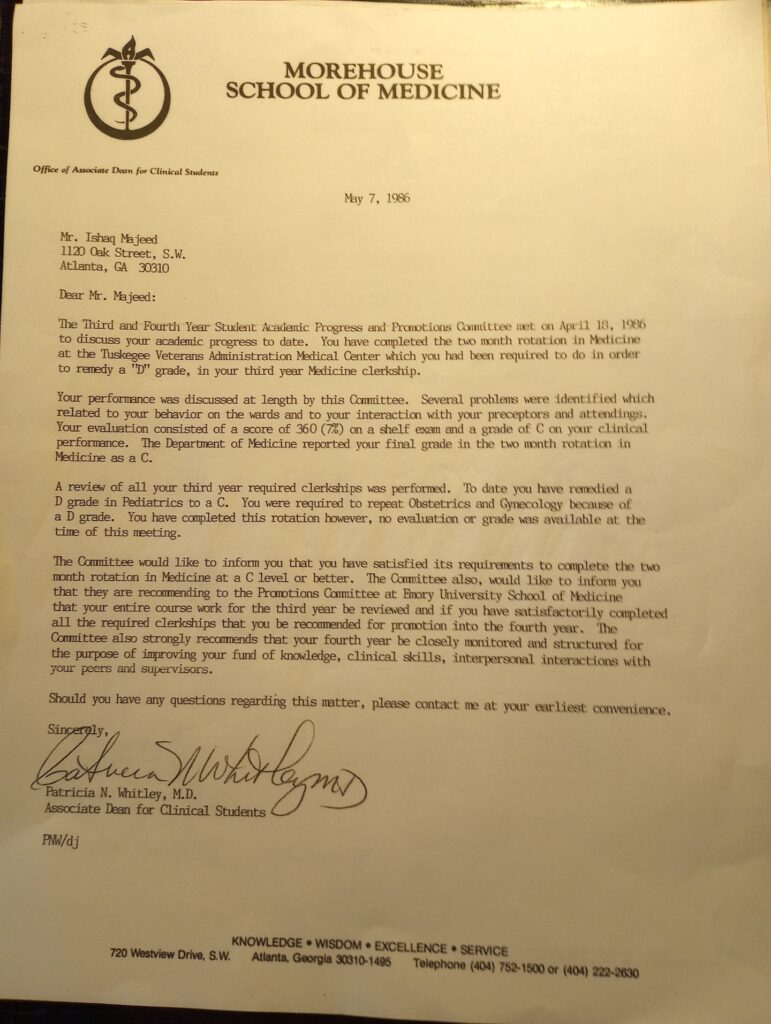
Every student begins medical school with the same dream: to one day stand as a doctor, trusted with the skills to care for patients’ health and wellness. For Ishaq Majeed, that dream began more than forty years ago on April 9, 1981, when he was admitted to Morehouse School of Medicine. But instead of a smooth path, he encountered discrimination while matriculating at Emory University School of Medicine during his third year — an injustice that would alter the course of his studies and his life. The fallout from this forced him into years of legal battles, personal sacrifice, and heartbreak. Still, he refused to let go of the vision Allah placed in his heart. Today, his story is not just about medicine — it is about holding on when others would have let go.
When I first learned of Dr. Majeed’s accomplishment, I was struck not only by the milestone itself but by the long road that led him there. His son, Ishaq II, had mentioned it in passing during a group call, and I found myself leaning in to confirm what I thought I heard: “Yes, my father just earned his MD at 75 years old.” That moment of awe quickly turned into conviction — this was a story that needed to be told. Too often, we hear only the struggles of Black men framed through deficit and stereotype. But here was a narrative of endurance, faith, and triumph that could inspire generations.
To capture the full depth of Dr. Majeed’s experience, I opened the invitation for others on the MANA Executive Committee to join the conversation. Two colleagues accepted — Imam Nadim Sulaiman Ali, MANA’s Secretary and a longtime friend of Dr. Majeed, and Malika Umar, MANA’s Network Coordinator and a recent Harvard graduate. Malika represents the next generation of Muslim leaders, and her presence added a powerful intergenerational dimension to the discussion. She was visibly moved by the exchange, later reflecting that Dr. Majeed’s perseverance made her think more deeply about purpose, faith, and what it means to endure through hardship.
That moment in the conversation — with Dr. Majeed’s voice seasoned by decades of struggle, Imam Nadim’s grounded in wisdom and spiritual leadership, and Malika’s bright with the energy of new beginnings — captured the essence of what this story represents: continuity. The passing of wisdom across generations — wisdom born of toil, struggle, important battles fought, and hard lessons learned.
Together, our intergenerational panel sought to explore not just the facts of Dr. Majeed’s life, but the lessons, faith, and resilience that have defined his path. What follows is the first in a series of articles chronicling his extraordinary journey — a story of perseverance, community, and the unyielding pursuit of dreams.
A Life of Service and Preparation

Before the battles in classrooms and courtrooms, Dr. Majeed’s path had already been one of service, discipline, and discovery — a journey that seems, in hindsight, to have been divinely preparing him for the tests ahead. Born Isaac Peterson on November 27, 1949, on a horse farm and raised in Waynesboro, Georgia, he grew up surrounded by faith, hard work, and the rhythms of rural life. A bright and determined student, he was class president each year of high school, played trumpet in the band, and excelled in both football and basketball. By his junior year, he was already working at Burke County Hospital, eventually becoming head orderly — an early sign of the healer’s heart that would later define his life.
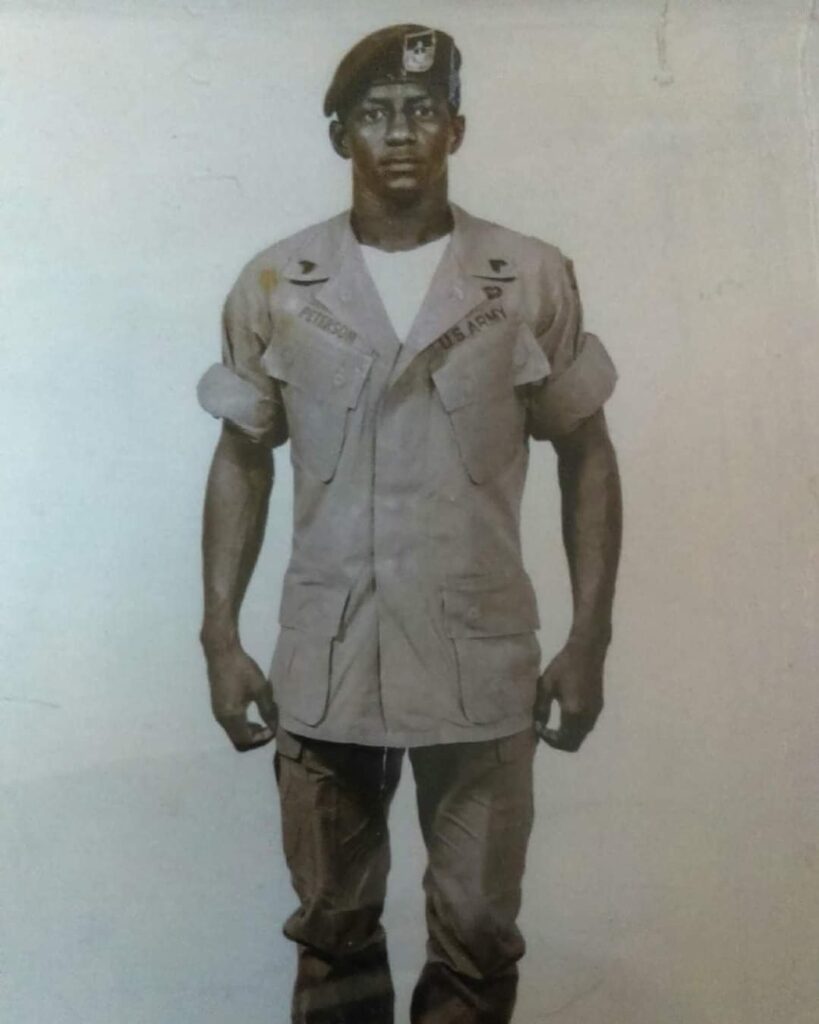
After graduation, he entered the U.S. Army and trained as a Green Beret medical specialist, rising to the rank of sergeant. His time in military medicine sharpened both his clinical skill and his sense of duty. Upon returning home, he earned a nursing license in 1972 and began working as a certified operating-room technician at Emory University Hospital. Never content to stop learning, he completed a Bachelor of Science in Chemistry, conducting laboratory research and eventually working with Dr. Zafar Israeli at the VA Hospital on tuberculosis studies involving veterans.
In each stage of his journey — soldier, nurse, scientist, teacher — he was guided by the quiet precision of Al-ʿAlīm (The All-Knowing), who prepares His servants for what lies ahead even when the purpose is hidden.
“Perhaps you dislike something while it is good for you, and perhaps you love something while it is bad for you; and Allah knows, while you know not.”
— Qur’an 2:216
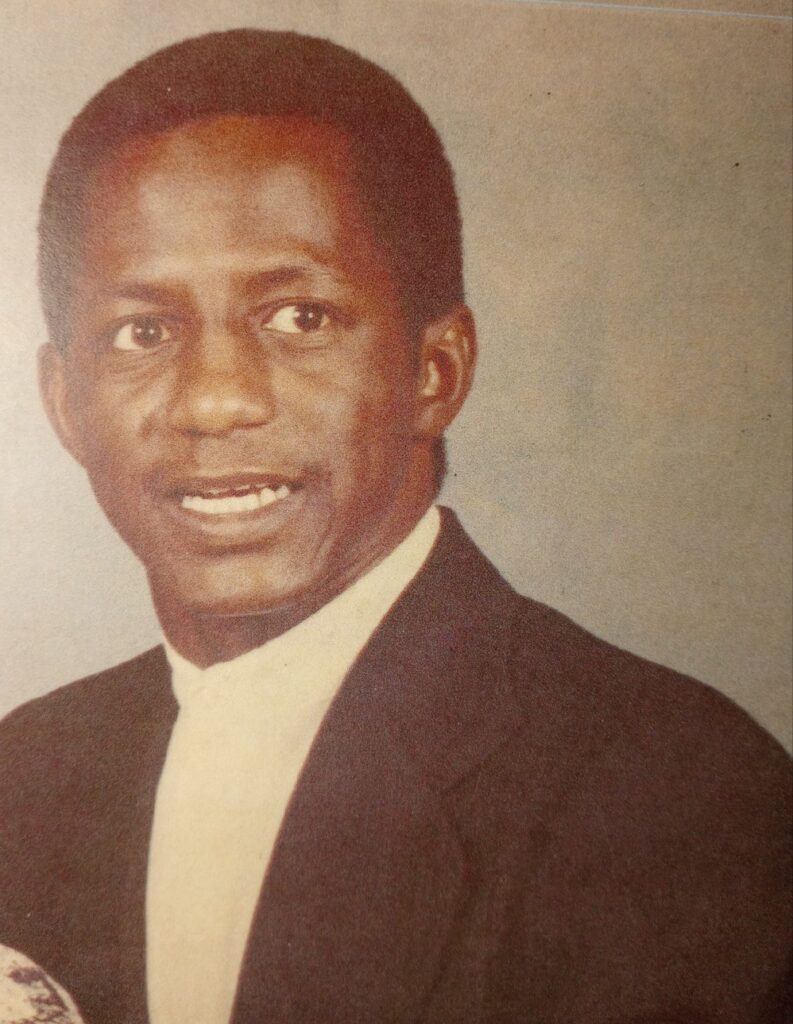
Years before finally earning his medical degree, Dr. Majeed was already serving his community through sharing his knowledge. Beginning in 1996, he taught chemistry and health sciences at Mohammed Schools of Atlanta, eventually becoming the Science Coordinator and Department Chair. His students remember a man who held them to high standards while modeling patience, perseverance, and faith — qualities that would soon be tested beyond measure.
By the time we spoke, I sensed that every chapter of Dr. Majeed’s life — from his upbringing in rural Georgia to the disciplined halls of the military and the laboratories of Emory — had prepared him for the struggle that would define his later years. It was as though Allah had been shaping his spirit long before he ever set foot in a medical classroom.
The Battle for Justice
So when I asked Dr. Majeed to take us back to his earliest days in medical school and describe the circumstances that led him to complete his degree after several decades, what he shared was not the story of an ordinary student’s challenge. It was a battle against systemic discrimination that left scars not only on his career but on his family life as well.
He started by discussing his initial experiences at Morehouse during the 1980s. “I had two children during my first two years of medical school,” he recalled. “During my third year of taking classes at Emory School of Medicine, I was met with a lot of discrimination. It was blatant from Emory doctors, and I documented them changing my grades.” During that same period, a conversation took place that, in Dr. Majeed’s view, marked a turning point in how he was treated. While discussing international issues with fellow residents — including the situation in Palestine and Israel’s occupation — he shared his perspective, grounded in justice and compassion. “I had remained quiet for days,” he recalled, “but when I finally spoke, everything seemed to change.” Not long after, subtle shifts in tone and treatment became unmistakable.
“Some of the doctors began to look at me differently,” he said. “Soon after that, my grades were changed.” Though he could never prove direct causation, the timing left a lasting impression on him. “From that moment, I was labeled a ‘radical Muslim,’” he reflected, a label that shadowed his years of study and, he believes, fueled the obstacles that followed.
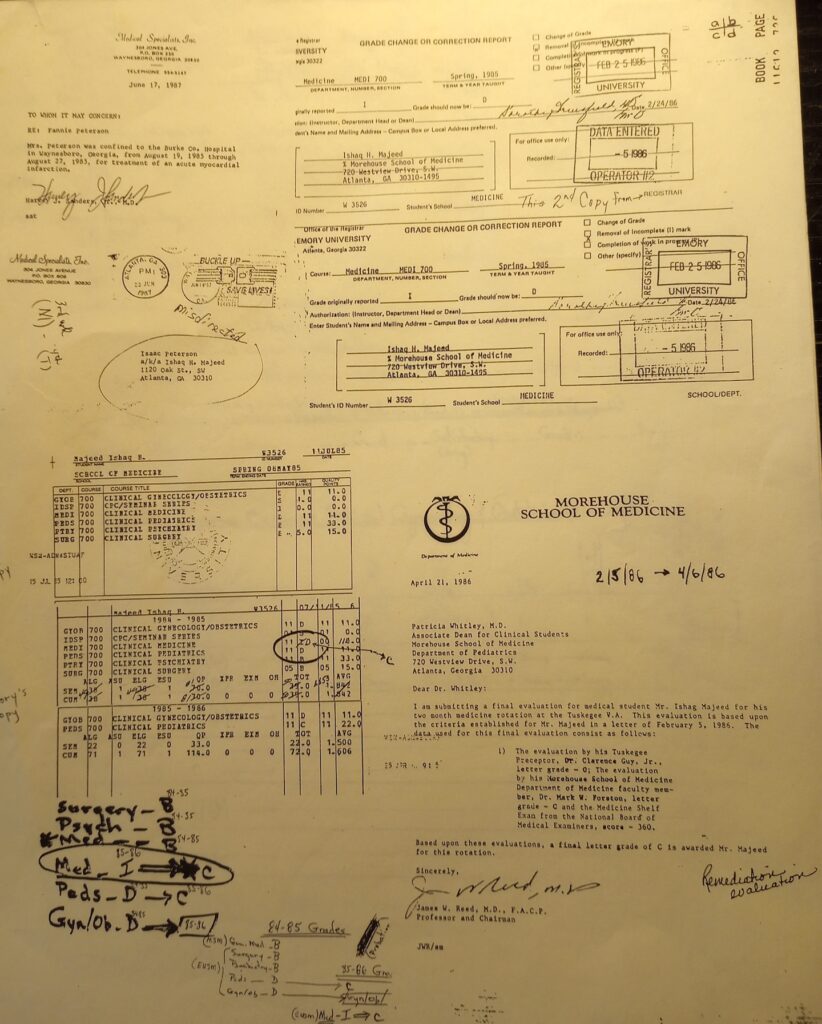
Rather than allow bitterness to consume him, Dr. Majeed responded with dignity, faith, and documentation. He carefully preserved records, correspondences, and evidence — not out of vengeance, but out of a deep belief that truth should always be preserved and shall prevail.
Despite having proof of his original grades, Dr. Majeed was given low marks during his third year and was denied an appeal at Emory School of Medicine, after which the struggle for justice began — a struggle that would last for decades.
Impact on Family Life
The challenges he encountered extended beyond the classroom. “All of my children were very young — extremely young — and we lost many much-needed benefits. We had free dental care and free medical care, both of which vanished.” The relentless strain — altered grades, financial burdens, lost scholarships, and grueling legal battles — placed immense pressure on his young family. His wife, Alice, worn down by years of uncertainty, hardship, and other overwhelming circumstances, ultimately found the struggle unbearable and decided to pursue separation and divorce.
The young Majeed children—three boys and one girl—lived with their mother for several years until the eldest turned 13, at which point the boys went to live with their father. No longer in medical school, he juggled the complexities of custodial parenting, working, and dealing with ongoing legal issues with quiet strength and dignity, supported by members of the community. Imam Nadim reflected on how Dr. Majeed never abandoned his dream of becoming a medical professional, consistently working in various roles within the healthcare field. He also recalled how Majeed remained steadfast in his dedication to the predominantly African-American masaajid in the Metro Atlanta area.
Despite the boys moving in with their father, their mother remained a steadfast and integral part of their lives, playing a vital role in their upbringing. She worked at Mohammed Schools, where nearly all the children completed their education from kindergarten through high school. The co-parenting arrangement provided the children with stability, guidance, and a strong sense of belonging, even after their parents’ marriage ended. “I always told my sons to respect and take care of their mother,” their father said firmly. Similarly, Alice was deeply committed to fostering a strong relationship between her children and their father.
A Heart Tested — Twice
His journey was further complicated by not one, but two life-threatening heart attacks in a single day. They occurred in February 2014 while he was at home, preparing legal documents connected to his decades-long fight over the changed grades at Emory. Thinking it was only heartburn, he delayed seeking care until the pain became unbearable. He was taken to the VA hospital, where doctors confirmed he was having a heart attack. They could not perform the surgery themselves because the cardiologists contracted for such procedures were from Emory Hospital. He was transferred just a few blocks away to Emory, where surgeons inserted a stent to open a blocked artery. The procedure seemed successful, and he was moved to the ICU.
But what happened next nearly cost him his life. Because his case initially appeared stable, Dr. Majeed was placed in a side room away from the main ICU, and his monitoring equipment was removed. For nearly five hours, he was left unmonitored. When the pain returned, his son, Ishaq II, repeatedly pleaded with the staff to check on him. Only then did doctors discover a second heart attack: blood had clotted around the stent, causing a 100% blockage in the critical artery that feeds the left side of the heart. Rushed back into surgery, he survived — yet with permanent damage. “You shouldn’t be alive,” one attending physician told him, repeating that for days to resident doctors who studied his case. The heart attacks left him weakened and even unable to fast during Ramadan for two years. He often wept from both the physical and emotional toll. To this day, he continues to pursue a malpractice case over the negligence that led to the second heart attack.
Yet what might have ended another man’s story became, for Dr. Majeed, only another chapter. With his life preserved against all odds, he pressed on — through the courts, through hardship, and ultimately, back into the classroom.
Triumph at Seventy-Five
The legal battle against Emory University and the VA hospital spanned over a decade, with Dr. Majeed fighting for his right to a jury trial and for the truth to be recognized. “They forgot one thing,” he said. “The constitutional right to a jury trial — and it’s invaluable in the U.S. Constitution, and especially in Georgia’s Constitution.”
But Dr. Majeed’s story is not just one of struggle — it is one of triumph. Offered a chance to complete his final year at the American International School of Medicine (AISM), he seized the opportunity, excelling in his studies and earning the respect of his peers and professors. “I was so well read and so up on things that the other medical students were learning from me. I earned great grades and countless good comments, alhamdulillah.”
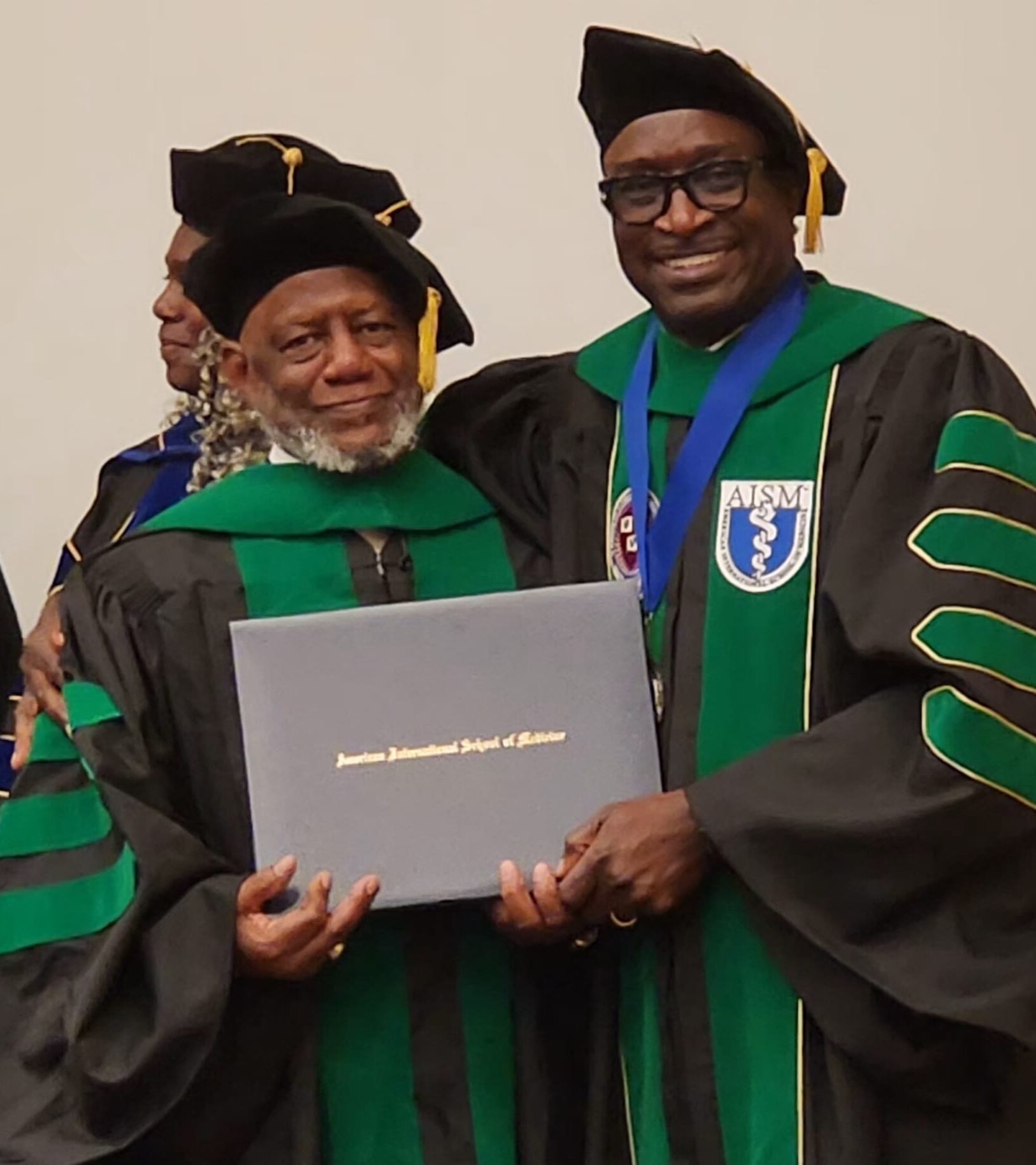
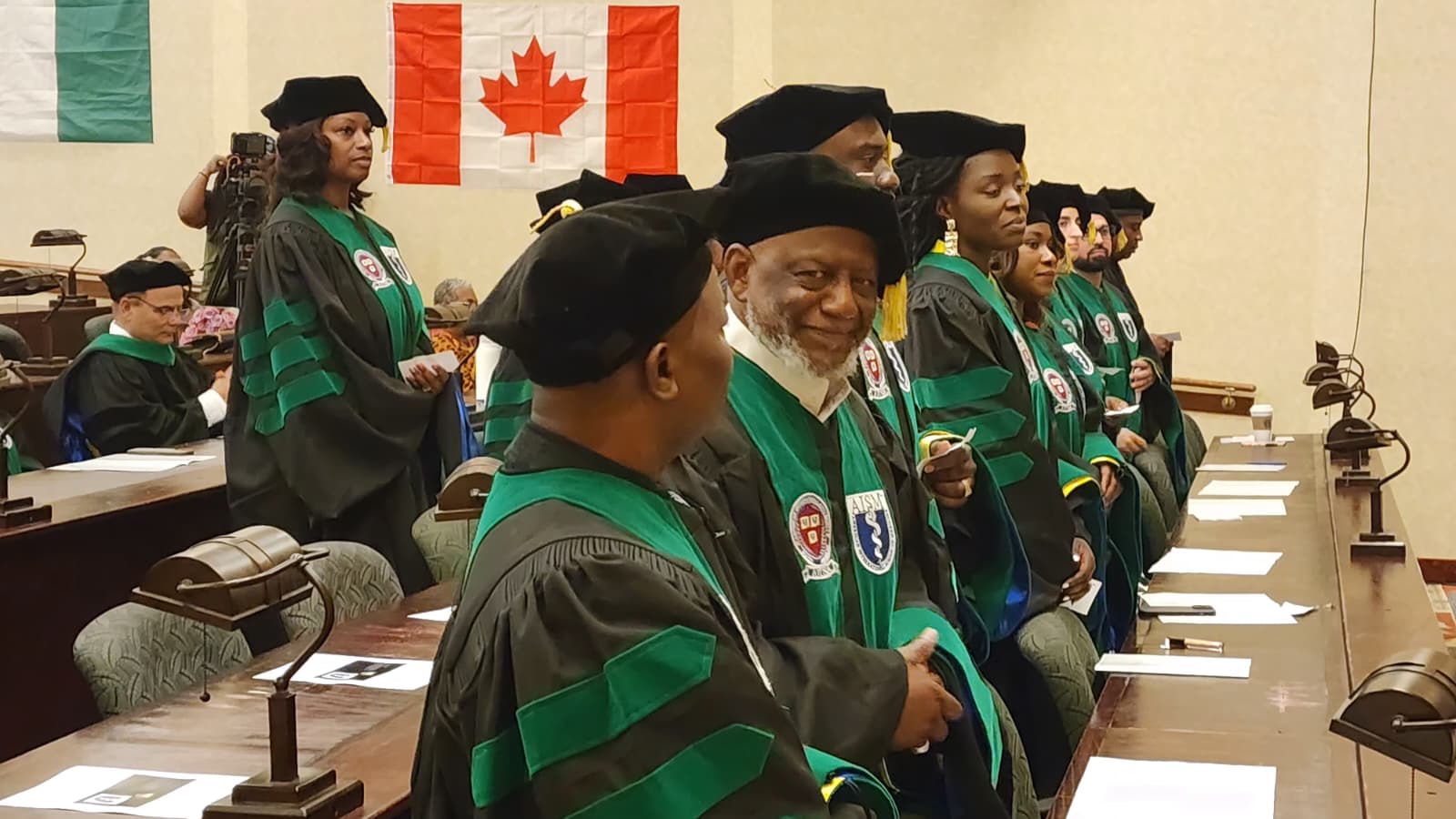
On July 25, 2025, as part of the summer graduating class of AISM, Ishaq Majeed — at the age of 75 — finally became Dr. Ishaq Majeed. The ceremony was witnessed by his family, friends, faculty, and classmates, many of them young enough to be his grandchildren. As his name was called, the room erupted in cheers. It was a moment heavy with pride and gratitude, marked by decades of struggle, discrimination, heartbreak, and disappointment. Yet there he stood, receiving his Doctor of Medicine degree with a warm smile — a living symbol of perseverance and faith. That day was more than a personal triumph; it was a testimony to Allah’s mercy, the strength of his family and community, and the unshakable resilience that carried him through.
Dr. Majeed described a moment during the graduation ceremony when all the new doctors were invited to share one of their “talents.” The atmosphere was a mix of humor and humility. When it was his turn, he smiled and said, “My talent is that I’m probably the oldest to ever graduate — seventy-five years old! Here I am, your example to keep going. Don’t ever give up. That’s my talent.” The audience responded with laughter and applause. His message, however, was deeply serious — about persistence, faith, and being an example for the generations that would follow.
Now, Dr. Majeed is committed to giving back. He dreams of establishing a pipeline between the Muslim community and AISM, inspiring young people to pursue their dreams regardless of age or circumstance. “It’s my goal to tie that medical school to our Muslim community. That’s what I want to do,” he said.
Legacy and Lessons
Dr. Majeed’s son, Ishaq II, perhaps said it best in a poem dedicated to his father:
“My father is a man who never gave up. He was always pursuing justice, even through all of the racism, injustice, and discrimination he faced. He always kept pushing forward. Today, after 40 years, he accomplished his goal of getting a medical doctor’s degree. Congratulations, Dad.”
Dr. Majeed’s journey is far from over. As he continues to fight for justice and inspire others, his story reminds us all that it is never too late to pursue our dreams — and that faith, perseverance, and community can overcome even the greatest of obstacles.
Key Takeaways from Dr. Majeed’s Story
1. Never Give Up, No Matter Your Age or Circumstances:
Dr. Majeed’s journey to earning his medical degree at 75 is a testament to lifelong learning and perseverance. As he said, “Study hard and keep going. Don’t give up on your example. That’s my talent — just keep going.”
2. Let Faith Guide You Through Challenges:
Dr. Majeed credits his faith for helping him endure and overcome adversity: “Blessed and glad I had the faith to follow along… Allah guides us by our faith, with our faith in what He says — that’s the way He guides us if we keep going far in the Faith.”
3. Advocate for Yourself and Stand Up Against Injustice:
Despite facing discrimination and institutional barriers, Dr. Majeed fought for his rights and for the truth, reminding us of the importance of self-advocacy and persistence.
4. Be an Example and Inspire Others:
Dr. Majeed’s story is not just about personal achievement but about inspiring the next generation, especially young Black boys and men who need examples of strength and endurance.
5. Value Community and Support Networks:
Throughout his journey, Dr. Majeed leaned on his family and community — a reminder of the power of shared struggle and mutual care.
6. It’s Never Too Late to Pursue Your Dreams:
Dr. Majeed’s life proves that age and setbacks do not define your potential. “You’re 50? Well, you’ve got 25 more years,” he would say. “Look at me — 25 more years, you’re 50.”
Dr. Majeed’s story is more than history — it is a mirror. Each of us has a dream we’ve set aside, and his journey asks: what would it mean to pick it back up?
This is Part One of Four chronicling Dr. Ishaq Majeed’s remarkable journey — a story of struggle, survival, and ultimate triumph.

Akanke is a native of Atlanta who now resides in Dayton, Ohio. She reverted to Islam in 1994 and is passionate about Islam and Islamic spirituality. Akanke is a graduate of Georgia State University, where she earned a degree in Communication, with a focus on film, TV, and cultural anthropology. Her career is diverse, and her interests span various creative forms of expression. From producing TV and radio shows to creating documentaries, writing, graphic design, and life coaching, she strives to make a lasting and authentic impact wherever she goes. Akanke has been a dedicated supporter of MANA since 2007, currently serving as the organization’s Board Vice President. In this role, she plays a key part in working with the Board President and Secretary to shape the organization’s trajectory. Additionally, she serves as MANA’s part-time Communications Director.





One Response
Alhamdulillah, wonderful story, and very well-narrated! Quite an inspiration for this 76-year old retired jurist! Thank you!