The Month of Jumada al-Awwal
As I continue learning about the months of the Islamic calendar, I’m discovering how much there is to explore beyond the names.
Jumada al-Awwal is the fifth month of the Islamic lunar calendar. Its name comes from the Arabic root j-m-d, meaning “to freeze” or “to become dry.” When the pre-Islamic Arabs named the months, this one fell in winter, when water froze and the land went dry.
Al-Awwal means “the first,” pairing it with Jumada al-Akhirah, “the second,” which follows. It is not one of the four sacred months and carries no prescribed rituals. Yet several significant events in early Islamic history took place within it, and among the best known is the Battle of Mu’tah.
This year, Jumada al-Awwal 1448 began around October 11–12, 2026, depending on local moon sighting.
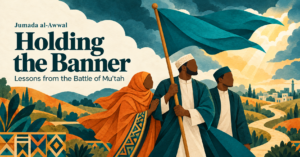
The Battle of Mu’tah
The Battle of Mu’tah took place in Jumada al-Awwal of 8 AH (about September 629 CE), near the village of Mu’tah, east of the Dead Sea in what is now Jordan’s Karak region.
It began with a grave breach of trust. Al-Harith ibn Umayr al-Azdi, an envoy carrying a letter to the ruler of Busra, was killed by Shurahbil ibn Amr, a Ghassanid chief allied with the Byzantine Empire. Killing an envoy violated one of the most firmly accepted customs of the time.
In response, the Prophet Muhammad, peace and blessings of Allah be upon him, sent an army of about 3,000. Unusually, he named three commanders in succession:
- Zayd ibn Harithah, to lead first
- Ja’far ibn Abi Talib, if Zayd fell
- Abdullah ibn Rawahah, if Ja’far fell
At Mu’tah, the Muslims met a far larger force of Byzantine troops and allied Arab tribes. The early sources give enormous figures that are likely exaggerated, but they reflect a real and overwhelming imbalance.
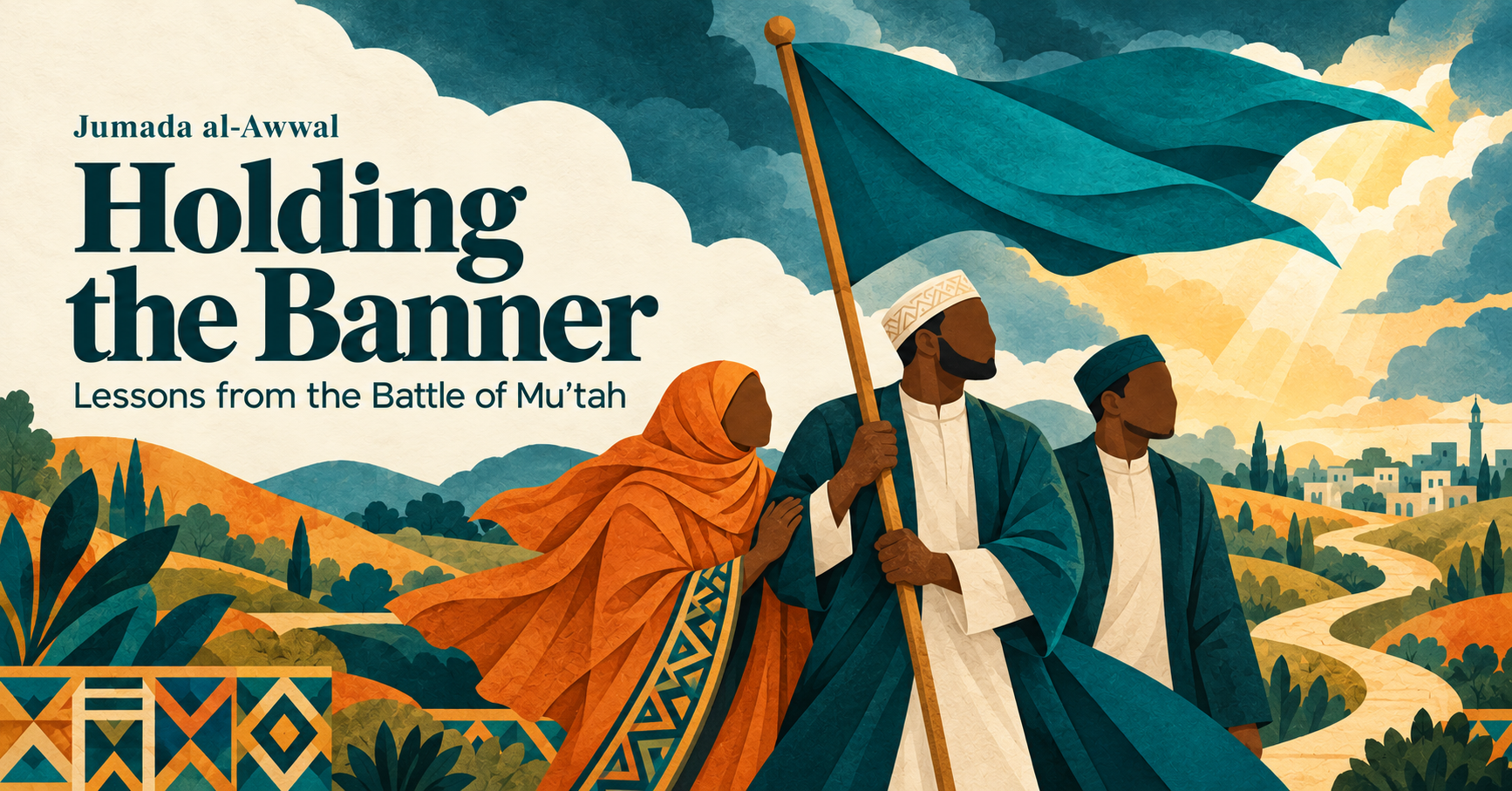
All three commanders were martyred in turn. Ja’far is reported to have kept the banner raised even after losing both arms. It is related that Allah replaced his arms with two wings in Paradise, which is why he is remembered as Ja’far al-Tayyar, “the one who flies.”
The companions then chose Khalid ibn al-Walid, who had embraced Islam only months earlier, to lead. He reorganized the ranks and carried out a skillful withdrawal that saved most of the army.
Back in Medina, the Prophet, peace and blessings of Allah be upon him, told the people what was happening as it unfolded, his eyes filled with tears. He described each commander taking the banner and falling, until it was taken up by “a sword from among the swords of Allah.” From that day, Khalid was known as Sayfullah, the Sword of Allah.
Why Mu’tah Matters
Mu’tah was the first major confrontation between the Muslim community and the Byzantine Empire. It was not a military victory, but a small army survived against overwhelming odds and returned home intact.
The battle set the stage for the expedition to Tabuk the following year and for the later campaigns into Syria. It is also remembered as a lasting lesson in sacrifice, in leadership succession, and in the wisdom of a strategic retreat.
A Lesson for Believers
One of the deepest lessons of Mu’tah is that faithfulness is measured by sincerity and steadfastness, not by the visible outcome.
By worldly standards, Mu’tah looked like a loss: three beloved commanders martyred and an army forced to withdraw. When the soldiers returned, some in Medina taunted them as runaways. But the Prophet, peace and blessings of Allah be upon him, corrected them: these men had not fled, he said, and they would return to the field, if Allah willed. He honored those who fell and gave Khalid a lasting title for the withdrawal. Allah judged them by what they gave, not by the scoreboard.
For us, this speaks to the many moments when we do what is right and the result doesn’t look like victory. We stand for justice, and nothing seems to change. We pour ourselves into family, community, or service, and the fruits don’t appear. Mu’tah reminds us that our task is to show up with integrity. The outcomes belong to Allah.
Several other threads run alongside this central lesson.
- Prepared hearts, not fragile ones. The three commanders were named before the army ever left. Loss was anticipated, not feared. Faith includes preparing for hardship, so that when it comes, the mission continues.
- Holding the banner with what remains. Ja’far kept the standard raised even after losing both arms. When we lose strength, resources, or the people we leaned on, we keep carrying what has been entrusted to us with whatever we have left.
- Wisdom is also courage. Khalid’s withdrawal preserved lives and the future of the community. Knowing when to step back, regroup, and protect what matters is not weakness. Sometimes it is the most faithful choice.
The Qur’an captures this spirit: “Among the believers are men who have been true to their covenant with Allah” (al-Ahzab 33:23).
Mu’tah is the story of people who were true, whatever the outcome looked like. As we move through Jumada al-Awwal, may we be counted among them.
A Closing Du’a
Our Lord, pour patience upon us, make our feet firm, and grant us victory (al-Baqarah 2:250).
O Allah, make us among those who are true to their covenant with You. Grant us the sincerity of Zayd, the steadfastness of Ja’far, the devotion of Abdullah ibn Rawahah, and the wisdom of Khalid.
When we stand for what is right and do not see the fruits, remind us that the outcome belongs to You. When we lose strength, help us carry what You have entrusted to us with whatever remains. Make our hearts prepared, not fragile, and make our feet firm upon Your path.
O Turner of hearts, keep our hearts firm upon Your religion.
And send Your peace and blessings upon our beloved Prophet Muhammad, his family, and his companions. Ameen.

Akanke is a communications specialist and consultant with a degree in Communication from Georgia State University, focused on film, TV, and cultural anthropology. Her career is diverse, and her interests span various creative forms of expression — from producing TV and radio shows to creating documentaries, writing, graphic design, and life coaching, she strives to make a lasting and authentic impact wherever she goes. She reverted to Islam in 1994 and is passionate about Islam and Islamic spirituality, a passion that runs through nearly every corner of her work. Akanke has been a dedicated supporter of the Muslim Alliance in North America (MANA) since 2007, currently serving as the organization’s Board Vice President — working alongside the Board President and Secretary to help shape MANA’s trajectory — and previously served for several years as its Communications Director. A native of Atlanta, she now resides in Dayton, Ohio.