Last month, Safar caught my attention.
This month, I continue paying attention. And what a month to pay attention to.
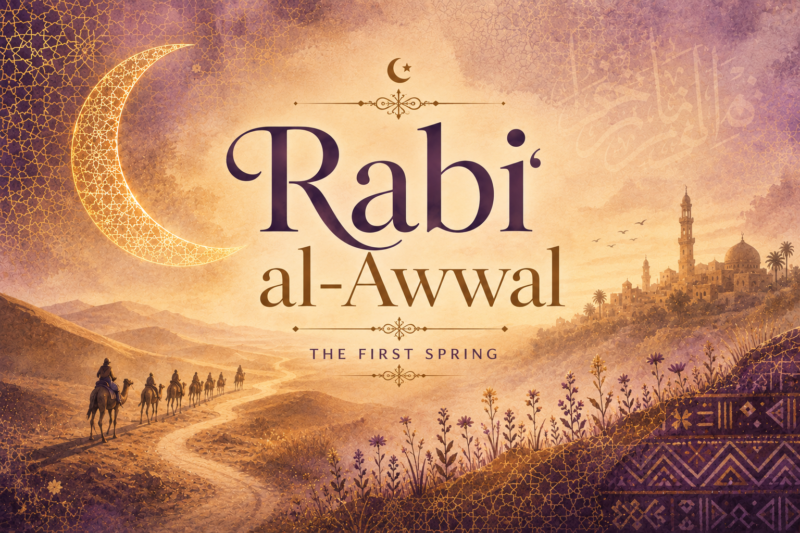
Rabiʿ al-Awwal (رَبِيع الأَوَّل) is the third month of the Islamic calendar, and even its name taught me something new. It means “the first spring.” Rabiʿ means spring, and al-awwal means the first.
The Arabic names of the months predate Islam, and Rabiʿ al-Awwal is understood to have been named when it coincided with spring. Because the Hijri calendar is lunar rather than solar, however, Rabiʿ al-Awwal doesn’t remain in spring. Like all the Hijri months, it moves through the seasons over the years.
I find something beautiful in discovering what these familiar Arabic names actually mean. Although I’ve heard Rabiʿ al-Awwal many times before, the name itself now opens a small window into language and history. A name I had heard for years suddenly contained an image: the first spring.
Safar, I discovered, carries a different image. Its name is commonly connected to emptiness—the emptying of homes when people traveled away. Now I move from Safar, with its linguistic memory of emptiness, into Rabiʿ al-Awwal, the first spring.
Significant Does Not Always Mean Sacred
One of the things I’m learning as I pay closer attention to the Hijri calendar is to distinguish between a sacred month and a historically significant month.
Allah tells us in the Qur’an:
“Indeed, the number of months ordained by Allah is twelve—in Allah’s Record since the day He created the heavens and the earth—of which four are sacred.”
— Qur’an 9:36
Rabiʿ al-Awwal is not one of those four sacred months. The four are Dhul-Qaʿdah, Dhul-Hijjah, Muharram, and Rajab. But Rabiʿ al-Awwal is profoundly significant in our history because of its relationship to the life of the Prophet Muhammad, peace and blessings be upon him.
The Prophet, peace and blessings be upon him, told us that he was born on a Monday. The exact calendar date of his birth, however, is a matter on which historical reports and later scholars have differed. The widely known 12th of Rabiʿ al-Awwal is one traditional view, but I think there is something important about learning to say, We know this; we have reports about that; and on this other detail, scholars have differed.
Learning Islamic history deeply also means learning where certainty ends.
A Month of Profound Moments in the Life of Prophet Muhammad, Peace and Blessings Be Upon Him
Rabiʿ al-Awwal is bound up with the life of the Prophet Muhammad, peace and blessings be upon him, in remarkable ways. It is traditionally associated with his birth, it was the month of his arrival in Madinah during the Hijrah, and it was also the month in which he returned to Allah.
That last part gives Rabiʿ al-Awwal another dimension. The month so often associated with love and joy in remembering the Messenger of Allah, peace and blessings be upon him, also carries the memory of an immeasurable loss. Historical reports differ regarding the precise date of his passing, but his death in Rabiʿ al-Awwal is well established.
And yet, between the remembrance of his birth and the remembrance of his passing, peace and blessings be upon him, lies another extraordinary part of his story: the Hijrah.
The Prophet, peace and blessings be upon him, and Abu Bakr, may Allah be pleased with him, left Makkah under extraordinary circumstances. But the Hijrah was more than an escape from persecution. Their journey brought them to Madinah, where Muslim communal life would take shape in a new way.
That gives me pause.
And when I pause to think about the Hijrah, I don’t only see movement from one city to another. I see community being built. I see the Muhajirun—the Muslims who migrated from Makkah—many of whom left behind homes, possessions, and familiar surroundings. I see the Ansar receiving them. I see Muslims having to build relationships, institutions, responsibilities, and a shared life around their faith.
But the word hijrah also carries a meaning that reaches beyond that singular historical migration. The Prophet, peace and blessings be upon him, taught that “the Muhajir is the one who abandons what Allah has forbidden.” Hijrah, then, also gives us a language for turning away from what displeases Allah and moving toward a life more pleasing to Him.
Inspired by that meaning, I begin thinking about us.
Hijrah, Transformation, and Our African American Muslim Story
As African American Muslims, we know something about disrupted inheritance.
Islam was present among some of our African ancestors long before later generations of Black Americans would struggle to recover and rebuild an Islamic inheritance in America. Enslavement severed people from languages, names, families, histories, and religious traditions. Yet Islam did not disappear completely from our story. Across generations, Black Americans found their way to Islam through different pathways and built communities increasingly rooted in the Shahadah and Tawheed.
For many African American Muslims who embraced Islam as adults, the idea of leaving something behind for the sake of Allah is more than an abstraction. We did not make the historic Hijrah of the Prophet Muhammad, peace and blessings be upon him, and his Companions, and I don’t mean to equate our experiences with theirs. But many of us eagerly left things behind for Allah—habits, relationships, environments, lifestyles, and ways of thinking and living that we came to understand displeased Him.
We were leaving some things behind as we learned what to build in their place.
And build we did.
We established masajid and Islamic schools, neighborhood institutions, and national organizations. We created businesses that allowed Muslim families to earn, employ, and serve their communities. We published newspapers, journals, and books so that we could tell our own stories and teach one another. We established schools where Muslim children could learn Qur’an alongside reading, mathematics, history, and science. We studied Arabic, memorized the Qur’an, traveled overseas in search of knowledge, and returned home to teach others.
Some of what we built became landmarks in African American Muslim life. Communities and institutions associated with Imam W. Deen Mohammed spread across the country. Muslim Journal gave our community a national voice. Clara Muhammad Schools educated generations of Muslim children. Organizations, including the Muslim Alliance in North America (MANA), emerged to address the needs and concerns of Muslims in America, with particular attention to communities that have too often been underserved.
But building community has never meant building perfectly. We struggled and still do. We disagreed and still do. Institutions changed. Some flourished, some disappeared, and some had to begin again.
Muslim Alliance in North America (MANA) itself is part of that story. After a period of dormancy, we had to regroup, rebuild, and recommit ourselves to the work. In that sense, the work we’re doing today is part of the continuing story of African American Muslims building institutions meant to strengthen and serve our community.
We built. We struggled. We rebuilt. And, by Allah’s permission, we are still building.
Telling Our Own Stories
Years ago, while producing my documentary project Miracle in America, I interviewed African American Muslims about their journeys to Islam. Again and again, they spoke about transformation—not simply adopting a new religious identity, but changing how they lived.
The late Imam Abdul Alim Bashir, may Allah have mercy on him, spoke candidly about the drugs, alcohol, and relationships he left behind when Islam entered his life. “All of those things went down the drain,” he said. “I transformed my life.” Then he said something that captures so much of what I heard in those interviews:
“We converted our lives from what it was before into a new way of life. Into a new way of life.”
Imam Abdul Alim Bashir, Miracle in America Project
Dr. Khadijah Askari described what that new way of life meant: “There is no separation between your life and worship of Allah.” Islam, she explained, affects “how you eat, what you eat, how you sleep, where you live, what type of job you get, who you marry, how you raise your children.”
My late husband, Nashid Abdul-Khaaliq, may Allah have mercy on him, helped me launch Miracle in America. Near the end of the trailer, we spoke about why we believed these stories needed to be preserved. Nashid said we wanted African American Muslims to be examples of how “the powerful words from the Qur’an can enter a person’s ears and heart and cause changes.” When I edited the trailer, I intentionally echoed those final words for emphasis: cause changes… changes… changes.
Listening to them again reminds me that Nashid and I weren’t simply documenting the transformation Islam had brought into other people’s lives. Islam changed our lives, too. We were part of the story we were trying to preserve.
Those voices came back to me as I learned more about the Hijrah while writing this article about Rabiʿ al-Awwal. The historic Hijrah and our individual journeys are not the same. But the testimonies of these believers illuminate something our Prophet, peace and blessings be upon him, taught us about leaving what Allah has forbidden and moving toward what pleases Him
Listen to some of those believers tell their stories in their own words in this video from Miracle in America, featuring interviews conducted in Atlanta in 2007.
Loving the Messenger, Peace and Blessings Be Upon Him, Beyond a Date
For many Muslims around the world, Rabiʿ al-Awwal is closely associated with remembering the birth of Prophet Muhammad, peace and blessings be upon him, including through gatherings commonly known as Mawlid. Muslims differ on formal Mawlid observances, and I don’t need to address that debate here. What we share is greater than the disagreement: we love the Messenger of Allah, peace and blessings be upon him.
Allah says:
“Indeed, in the Messenger of Allah you have an excellent example for whoever has hope in Allah and the Last Day, and remembers Allah often.”
— Qur’an 33:21
Perhaps Rabiʿ al-Awwal can invite us to ask not only how we express our love for Prophet Muhammad, peace and blessings be upon him, but how that love appears in the way we live. Do I know his life? Do I know what he stood for? Do I recognize his mercy, courage, patience, justice, generosity, devotion to Allah, and concern for his community? And is knowing him changing me?
For me, those questions make Rabiʿ al-Awwal much bigger than a date on a calendar.
As I continued learning, an excerpt from a documentary series about the Prophet, peace and blessings be upon him, seemed fitting. In it, Shaykh Mahy Cisse of Medina Baye, Senegal, spoke about loving and honoring the Prophet as an expression of honoring Allah, careful never to attribute divinity to him. Imam Johari Abdul-Malik took the reflection further, describing love of the Prophet, peace and blessings be upon him, as a path toward greater love of Allah — loving what Allah loves.
That reflection stayed with me. Perhaps learning more about the Prophet, peace and blessings be upon him, isn’t simply about accumulating information about his life. Perhaps knowing him more deeply can teach us to love more deeply, while always remembering that our worship belongs to Allah alone.
SubhanAllah.
I’m Still Paying Attention
Last month, Safar caught me paying attention. This month, Rabiʿ al-Awwal is showing me how much there is to see when I do. I’m grateful that I’m cultivating a deeper relationship with the Islamic calendar by asking what these months can teach me about the deen, our history, and the community to which I belong.
And yes, I’m still learning the order. But this time, when Safar ended, I knew what came next: Rabiʿ Al Awwal. The first spring.
And now I know more of its story.
When this month ends, another will arrive. And, insha’Allah, I’ll meet you there.
What might change in our relationship with Islam if we stopped merely passing through its calendar and began paying attention to what its months invite us to learn?

Akanke is a communications specialist and consultant with a degree in Communication from Georgia State University, focused on film, TV, and cultural anthropology. Her career is diverse, and her interests span various creative forms of expression — from producing TV and radio shows to creating documentaries, writing, graphic design, and life coaching, she strives to make a lasting and authentic impact wherever she goes. She reverted to Islam in 1994 and is passionate about Islam and Islamic spirituality, a passion that runs through nearly every corner of her work. Akanke has been a dedicated supporter of the Muslim Alliance in North America (MANA) since 2007, currently serving as the organization’s Board Vice President — working alongside the Board President and Secretary to help shape MANA’s trajectory — and previously served for several years as its Communications Director. A native of Atlanta, she now resides in Dayton, Ohio.