Every year, during these sacred days of Dhul Hijjah, millions of hearts begin turning toward Makkah.
Some will physically make the journey of Hajj this year. Others will stand at a distance longing for it, watching the pilgrims clothed in white, moving together in remembrance of Allah, answering the ancient call first made by Prophet Ibrahim, peace be upon him.
And every year, as I reflect on Hajj, I find myself thinking deeply about struggle.
Not only the struggle of the pilgrims traveling across the world. Not only the struggle of standing for hours in worship. Not only the physical exhaustion of the journey itself. But the sacred struggle woven into the very foundation of Hajj.
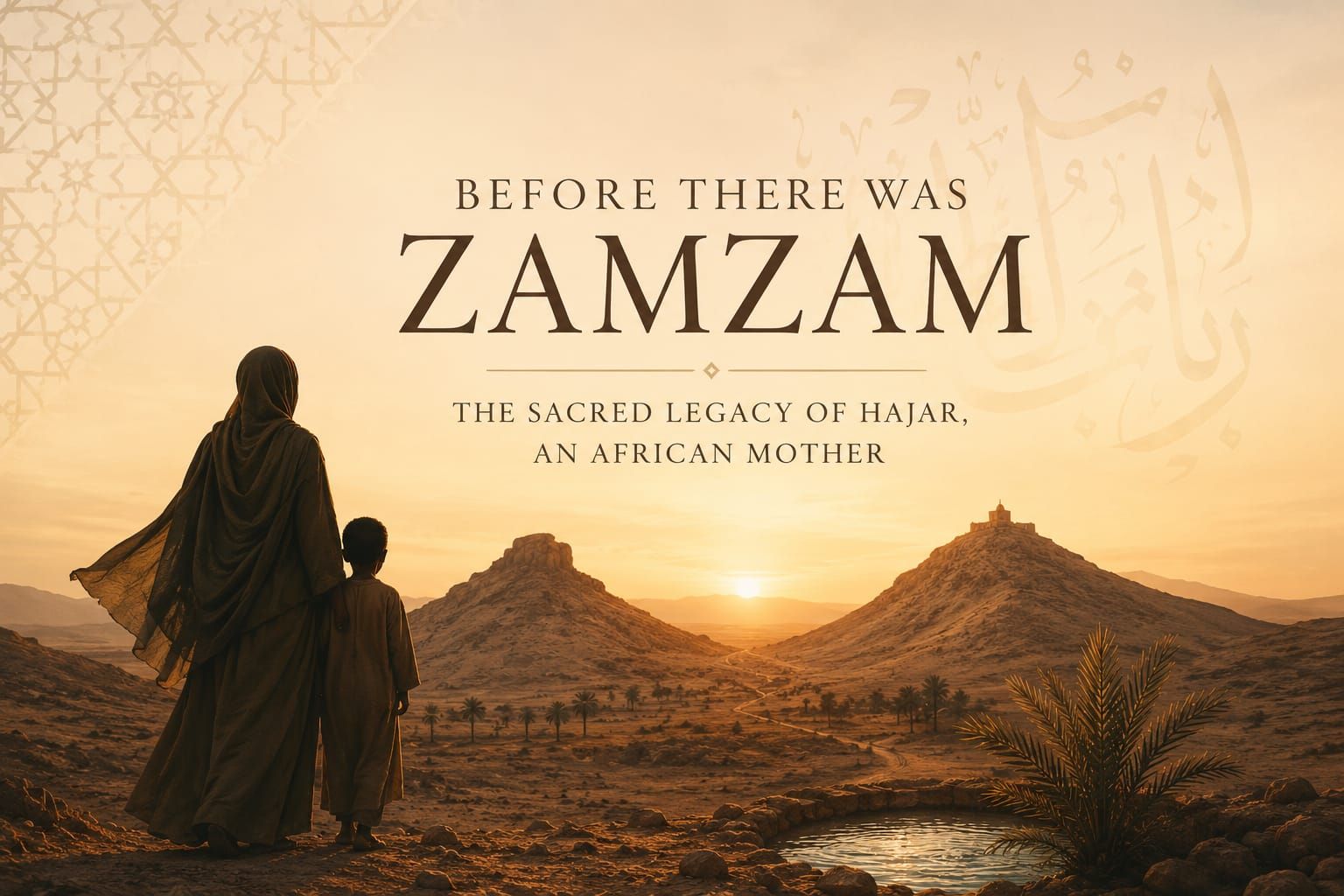
Because before there was Zamzam, there was Hajar (may Allah be pleased with her).
Before there was relief, there was desperation.
ÀBefore there was water, there was running. Before there was ease, there was trust in Allah in the middle of uncertainty.
And I think there is something profoundly important about the fact that one of the most sacred rituals in Islam centers the footsteps of an African woman.
Hajar was an African woman.
A mother.
A wife.
A woman left in the desert with her child.
A woman searching for water beneath the burning heat with no visible sign that relief was coming.
Can you imagine her heart?
Can you imagine the fear of hearing your child cry from thirst? Can you imagine running between Safa and Marwa not knowing whether help would come, but refusing to stop searching anyway?
And yet Allah honored her struggle so greatly that millions of believers would one day retrace her footsteps until the end of time.
Glory be to Allah!
What the world may overlook, Allah honors. What society may consider weak, insignificant, disposable, or forgotten, Allah can elevate into sacred history.
Every year, millions follow the path of an African mother who kept going.
That reality carries profound meaning for me. Because when I think about the history of African American people, and especially Black women, I see echoes of Hajar’s spirit everywhere.
I think about generations of Black mothers carrying families through unimaginable hardship. Women preserving dignity in the midst of degradation. Women holding communities together while carrying their own grief silently. Women surviving displacement, oppression, separation, injustice, and exhaustion — yet continuing to move forward in faith.
Still searching.
Still praying.
Still carrying their children.
Still believing Allah could make a way where there appeared to be none.
And perhaps that is part of what Hajj teaches us: that sacred struggle is not meaningless.
Allah sees it.
Allah saw Hajar running through the desert.
Allah saw Ibrahim, peace be upon him, surrendering what he loved for His sake.
Allah saw Ismail, peace be upon him, in submission and trust.
And Allah sees us too.
The rituals of Hajj are not disconnected movements without meaning. They are living remembrances of surrender, perseverance, sacrifice, longing, obedience, and trust.
Even the garments of ihram carry a message.
Titles disappear.
Status disappears.
Wealth disappears.
Human beings stand before Allah stripped down to their humanity.
And in a world obsessed with hierarchy, race, power, and social status, Hajj reminds us that our worth has never come from the systems of this worldly life.
Our dignity comes from Allah.
I think that is part of why Malcolm X’s Hajj experience transformed him so deeply. In Hajj, he witnessed something beyond nationalism, beyond racial categories, beyond worldly divisions. He witnessed human beings standing together before their Creator as equals.
What a powerful thing to witness for a people whose history has included so much struggle around human dignity itself.
And perhaps this is why these sacred days feel so emotionally weighty for many of us.
Because we understand struggle. We understand sacrifice. We understand journeys that require endurance long before relief appears. We understand what it means to keep moving while trusting Allah.
Dhul Hijjah reminds us that faith is not always soft and easy. Sometimes faith looks like Hajar running through the desert. Sometimes faith looks like Ibrahim placing complete trust in Allah even when he does not understand the outcome.
Sometimes faith looks like sacrifice. Sometimes faith looks like perseverance. And sometimes faith looks like simply continuing forward when your heart is tired.
But the story of Hajar reminds us of something beautiful: Allah can bring Zamzam from the very place where we thought we might break. The very ground beneath our hardship may contain a mercy we cannot yet see. What feels like the edge of despair may become the place where Allah opens a new source of life, strength, healing, or nearness to Him.
May Allah allow us to embody the trust of Hajar, the surrender of Ibrahim, and the obedience of Ismail, during these sacred days. May He honor the struggles we carry quietly. May He transform our hardship into nearness to Him. And may He allow us to remember that no sincere step taken toward Allah is ever unseen.
Ameen.

Akanke is a communications specialist and consultant with a degree in Communication from Georgia State University, focused on film, TV, and cultural anthropology. Her career is diverse, and her interests span various creative forms of expression — from producing TV and radio shows to creating documentaries, writing, graphic design, and life coaching, she strives to make a lasting and authentic impact wherever she goes. She reverted to Islam in 1994 and is passionate about Islam and Islamic spirituality, a passion that runs through nearly every corner of her work. Akanke has been a dedicated supporter of the Muslim Alliance in North America (MANA) since 2007, currently serving as the organization’s Board Vice President — working alongside the Board President and Secretary to help shape MANA’s trajectory — and previously served for several years as its Communications Director. A native of Atlanta, she now resides in Dayton, Ohio.