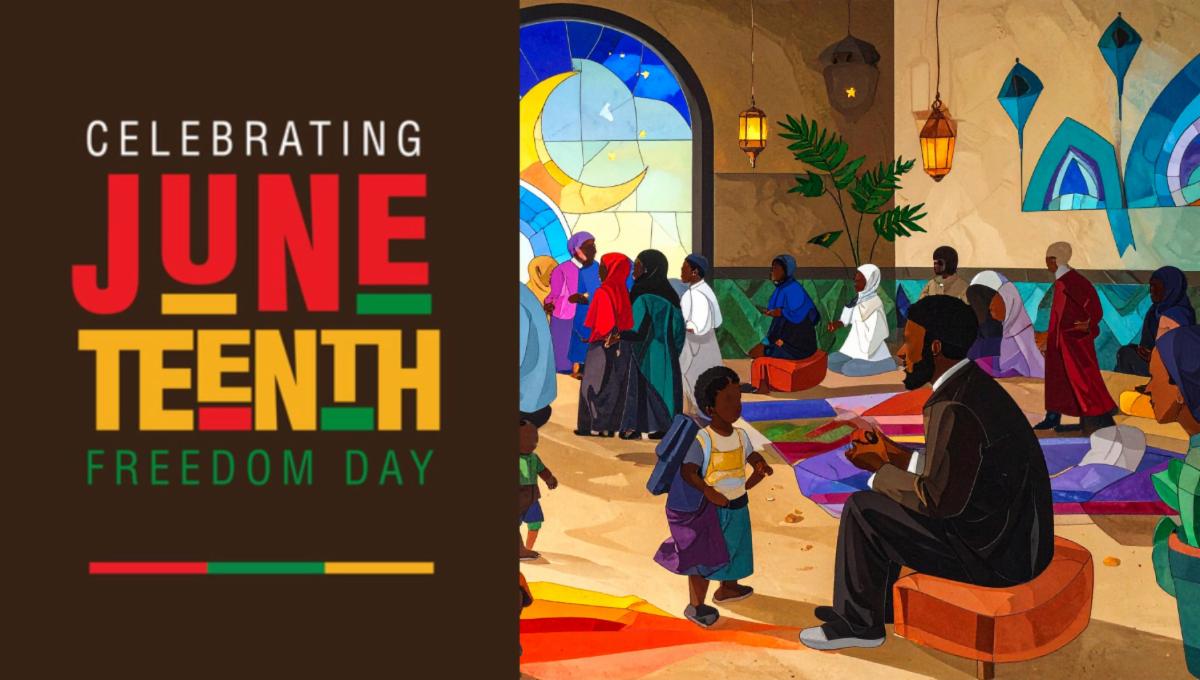
Juneteenth presents an opportunity to better understand an important chapter in American history and the arduous journey toward freedom and justice. While people may hold different views about commemorating holidays or historical observances, understanding the significance of Juneteenth is not about politics—it is about knowledge, empathy, and an honest engagement with our shared past.
For Muslims, this moment offers something even deeper. It is an opportunity to reflect on the values our faith calls us to uphold: justice, human dignity, gratitude, perseverance, and standing with those who have endured oppression. It is also an opportunity to learn more about the rich and deeply layered African American experience—one shaped by profound hardship, extraordinary resilience, enduring faith, and immeasurable contributions to our nation.
In doing so, we also gain a greater appreciation for the legacy of African American Muslims, whose scholarship, institution-building, leadership, and steadfast commitment to Islam have been foundational to the story of Islam in America. Their sacrifices and contributions have not only sustained generations of believers but have also helped establish and strengthen the vibrant Muslim community we know today.
At MANA, we believe that learning one another’s stories strengthens our collective future. The more we understand the experiences that have shaped our brothers and sisters, the more capable we become of building authentic relationships rooted in mutual respect, shared purpose, and love for the sake of Allah.
With that spirit in mind, we are pleased to share two resources to support thoughtful engagement with Juneteenth: a khutbah outline exploring themes of freedom, faith, justice, and moral responsibility through an Islamic lens, and a panel discussion guide designed to encourage meaningful conversations about history, resilience, identity, and our shared future.
These resources are offered not to tell communities what they should think, but to encourage learning, reflection, and dialogue. They invite us to approach Juneteenth with curiosity rather than assumption and with a sincere desire to better understand one another.
The African American Muslim experience is not a sidebar to the American Muslim story—it is one of its foundational chapters. By taking time to learn that history, we honor those who came before us, strengthen the bonds of our diverse ummah, and equip ourselves to move forward together with greater wisdom, compassion, and unity.
May Allah increase us in beneficial knowledge, deepen our appreciation for one another’s journeys, unite our hearts upon truth, and enable us to be among those who listen, reflect, and act with justice and sincerity. Ameen.

Akanke is a communications specialist and consultant with a degree in Communication from Georgia State University, focused on film, TV, and cultural anthropology. Her career is diverse, and her interests span various creative forms of expression — from producing TV and radio shows to creating documentaries, writing, graphic design, and life coaching, she strives to make a lasting and authentic impact wherever she goes. She reverted to Islam in 1994 and is passionate about Islam and Islamic spirituality, a passion that runs through nearly every corner of her work. Akanke has been a dedicated supporter of the Muslim Alliance in North America (MANA) since 2007, currently serving as the organization’s Board Vice President — working alongside the Board President and Secretary to help shape MANA’s trajectory — and previously served for several years as its Communications Director. A native of Atlanta, she now resides in Dayton, Ohio.