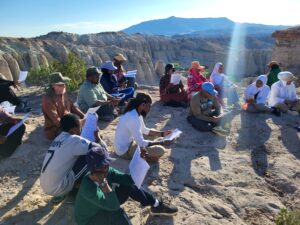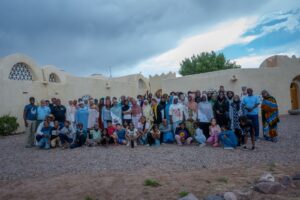
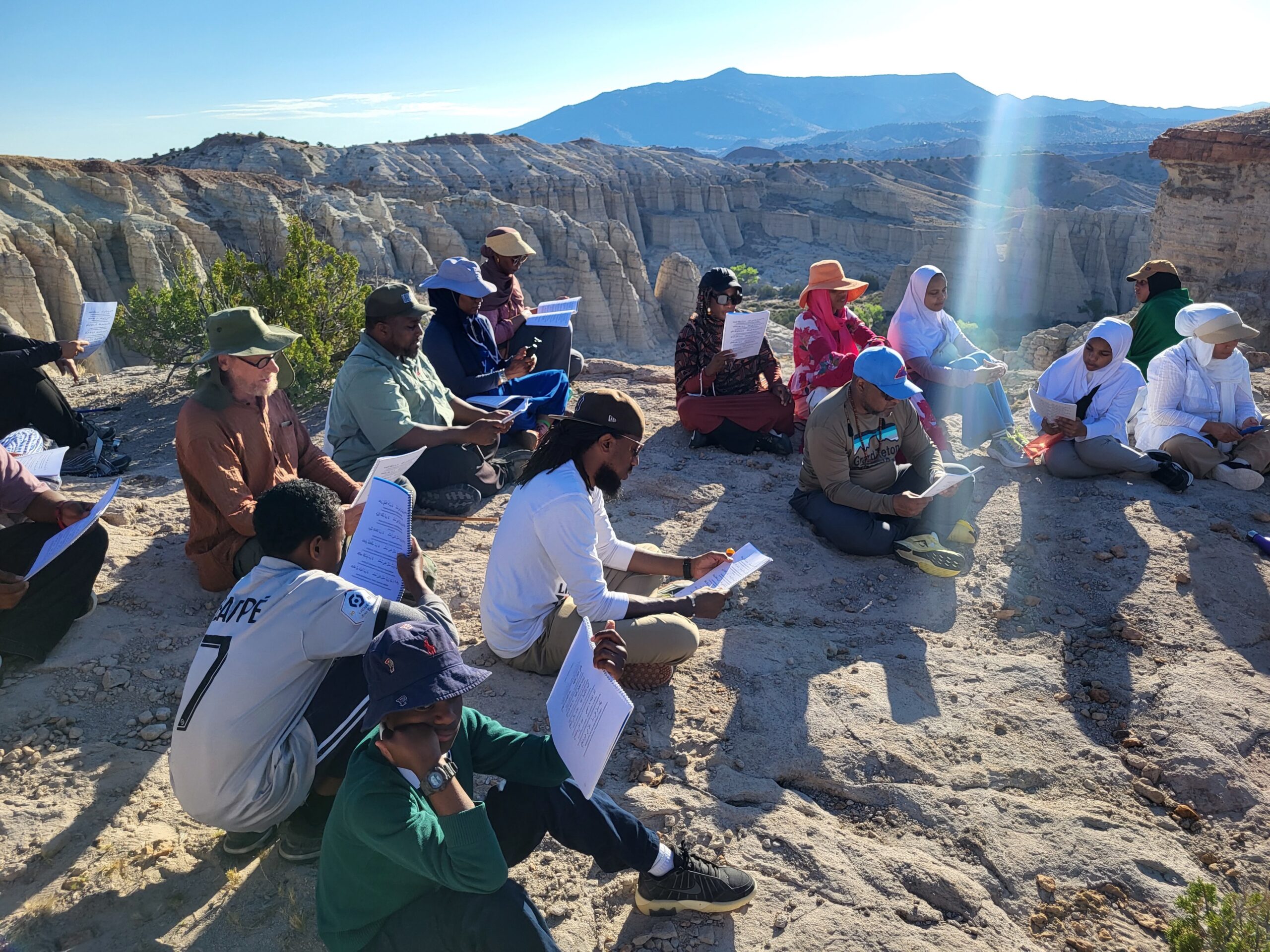
I almost didn’t attend this year’s Black Muslim Family Retreat. After spending most of my adult life as a wife and mother of five, I am still adjusting, three years post-divorce, to the changed shape of my family. My adult children are living lives of their own; my younger two were traveling with their father this summer; neither of my sisters or their families could attend, so I would be arriving at this family retreat entirely on my own.
What does someone arriving without family do at a family retreat?
When I first saw a flyer for this year’s retreat posted in a Whatsapp group chat, I read it and kept scrolling. The next day, one of my closest friends forwarded the same flyer to me. I thanked her, told her I had seen it, and dismissed it again.
But it stuck with me.
Two weeks later, I was the one forwarding the flyer to my sisters, asking their advice as I tried to decide if I wanted to be spontaneous and sign up to go to a family retreat alone or ignore that flash of spontaneity so my future introverted self wouldn’t be kicking my past, momentarily extroverted self. And there were plenty of reasons for future-me to object. In addition to not being able to attend with any of my family, I didn’t know anyone else who was going. I had never heard of the AHAD Collective, the community organizing it. I had visited Abiquiu as a teenager and was miserable most of the time I was there due to what I would later come to identify as my tendency to develop altitude sickness whenever I’m more than 5,000 feet above sea level. I’m trying to get my financial house in order and I hadn’t budgeted for this expense, etc., etc., etc.
But it stuck with me. So between my sisters’ enthusiastic encouragement, learning that the AHAD Collective was founded by Imam Adeyinka Mendes and Ustadha Rukayat Yakub, a couple of whom I had only heard good things, the retreat advertisements repeatedly emphasizing that the retreat was for families and singles, the cost of attending being very reasonable, and the availability of prescription drugs that are effective in combatting the effects of altitude sickness, there was an answer for almost every one of my excuses, so the momentary flash of extroversion lingered, and I registered.
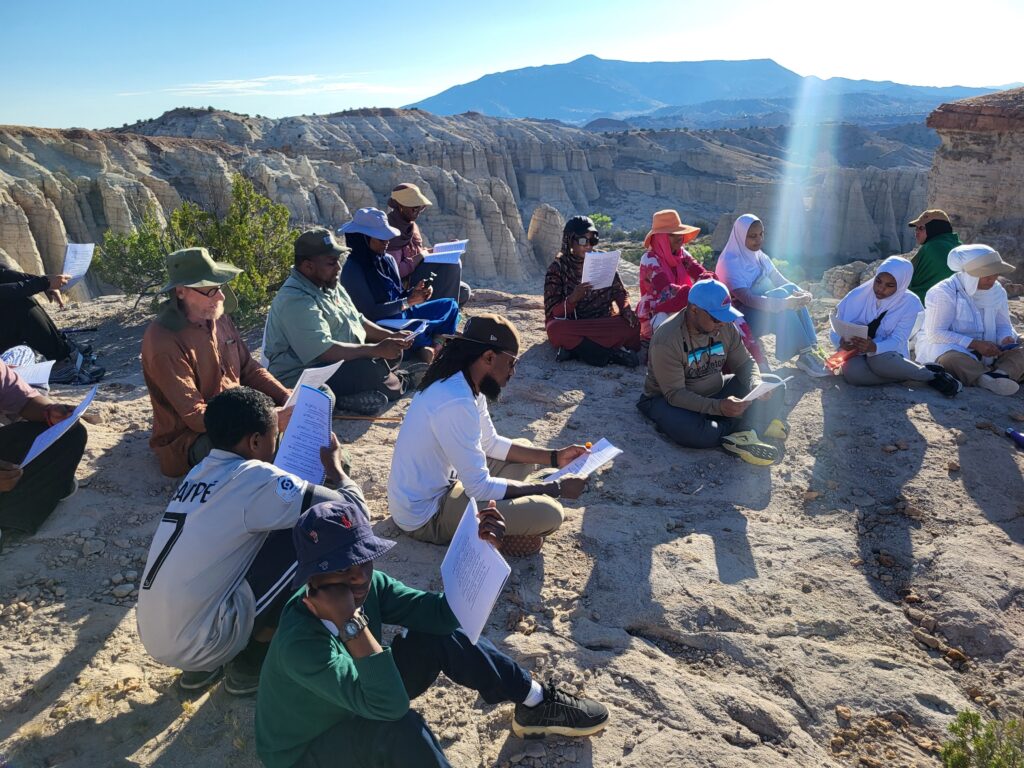
And even though the anxiety around being family-less at a family retreat remained, I figured I could always throw myself into the group spiritual dimensions of the retreat and then, in true introverted style, find a quiet place to be by myself during mealtimes and other family-centered moments. When I joined the virtual orientation and saw the full schedule, I was convinced that plan of action would be sufficient to make this a meaningful experience for me. After all, the rhythm and flow of the days seemed very similar to another Muslim family retreat I’d attended on the east coast with my sister’s family last year, and I thought I knew what to expect: days that began before dawn with tahajjud, followed by Fajr, communal remembrance, a post-Fajr class, and salat al-Duha, with classes and other programming continuing throughout the day and ending after Isha. This would be an experience that would leave me physically exhausted but spiritually replenished, just surrounded by other Black Muslims this time.
Except that isn’t what happened.
Between a cycle that came days earlier than expected and the effects of the change in altitude, despite the medication or maybe because of it, an exhaustion settled over me that I couldn’t seem to shake. Morning after morning, despite my plans to get up and still be present with the group during tahajjud and through the post-Fajr classes, I simply could not make my body cooperate, and since one of the principles they’d shared with us during the orientation session was the importance of rest and treating it as a form of resistance, I wasn’t going to fight my body.
The fact that I had come expecting an intensely personal spiritual immersion, just in a group setting, but was sleeping through what I felt to be the most important portions of it, initially felt like a loss. But Allah opens doors where we least expect them, and in my case, it was the kitchen door.
The organizers had invited us to volunteer a few weeks before the retreat, emphasizing that this was a community gathering, the creation of a village that would take all of us working together to make it successful. I had every intention of signing up, but when I opened the form and saw that it required committing to specific shifts before I had a clear sense of the retreat schedule, I put it aside and forgot to revisit it. Then, after one of our first meals, Ustadha Rukayat asked for volunteers to help with kitchen cleanup. I volunteered, assuming I was signing up for a short stint in the kitchen.
A few hours later, I was still there, and when I finally made it to the tail end of the session that was in progress, one of the first things I heard was Ustadh Rhamis Kent referencing a hadith about Allah aiding His servant as long as that servant is in service to others. It took everything in me not to burst into tears in that moment, because with that, I knew exactly what Allah had decreed to fill my cup in place of the acts of worship that I’d expected to partake in.
So I went back to the kitchen after another meal. And another. Before long, if I wasn’t in one of the retreat sessions, there was a pretty good chance I could be found in the kitchen washing or drying dishes, putting things away, wiping things down, or doing whatever else needed to be done. The irony was not lost on me. I don’t particularly enjoy cooking, and no one who knows me would mistake me for the family chef.
But I loved being in that kitchen because that kitchen felt like home.
There was something about the rhythm of the three sisters who carried much of the responsibility for feeding our little village: the sounds and smells, the conversation, the constant movement of preparing one meal while the rest of us were still enjoying the last. The food they prepared was thoughtful and nourishing, homestyle cooking, the kind that makes your body and soul feel cared for. And it was good, really, really good, mashaAllah.
Watching these women prepare food for a community felt deeply familiar. It reminded me of my paternal grandmother, one of the cooks in our family and one of the people whose home gathered everyone together for holidays. It reminded me of my maternal grandfather, who loved to cook and entertain and whose home served much the same role on my mother’s side. Some of my earliest understandings of family, of gathering and belonging, are tied to people who fed me.
But the nourishment happening in that kitchen wasn’t only coming from the food. There were conversations that happened in that kitchen, of both the lighthearted and deep variety. One conversation between a few of us turned unexpectedly vulnerable as we talked about the test of loving our adult children through choices and struggles we cannot control; about holding fast to what we believe without allowing our convictions to snuff out our compassion; and about the difficult work of recognizing when our children’s lives must ultimately be entrusted to Allah. We barely knew one another, yet we were sharing the kinds of things mothers usually carry quietly unless they’re in the safest of spaces.
That sense of quiet sisterhood followed me outside the kitchen. At nearly every meal, I found myself sitting with a different group of sisters, most of whom I had never met before this retreat. Ordinarily, that much interaction with strangers would have required a level of social energy I, as an introvert, simply do not possess. But these conversations came easily, and they didn’t drain me. They rooted me.
Over breakfast, lunch and dinner, we talked about our families, our work, our lives, the communities we hailed from, how we had found our way to the retreat. I spoke with women older than me and younger than me, and because Black don’t crack, half the time I couldn’t have told you which was which. In those conversations, I kept hearing echoes of my own life and the lives of people in my family reflected in someone else’s story.
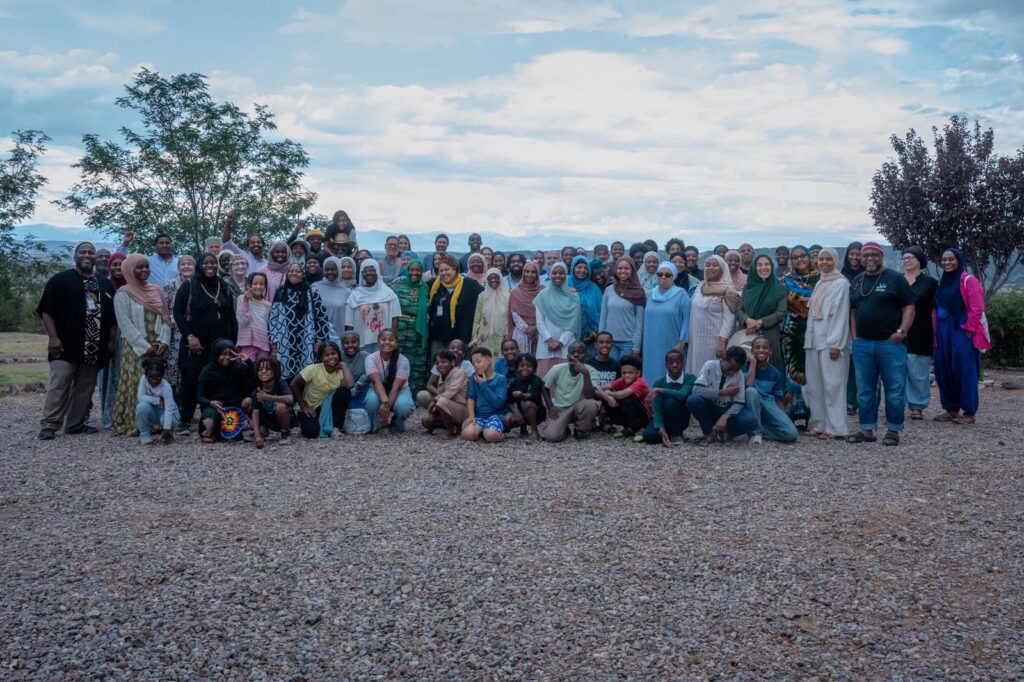
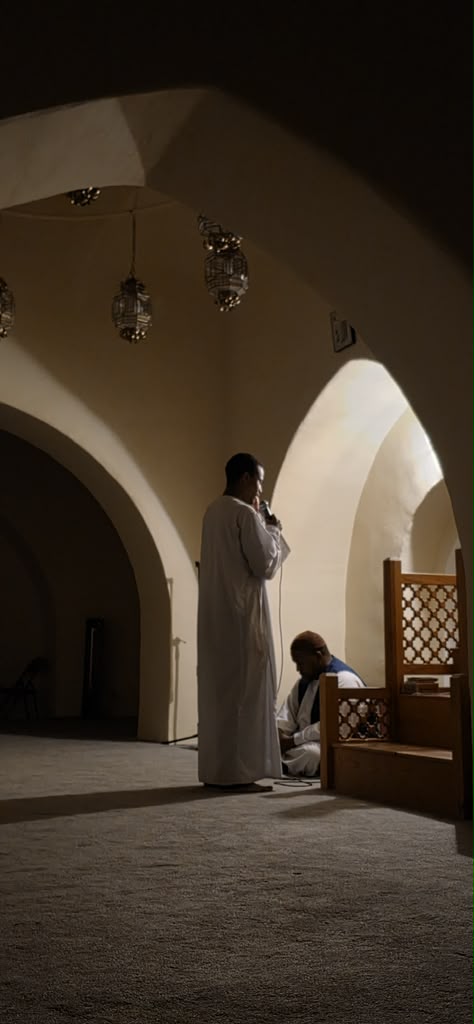
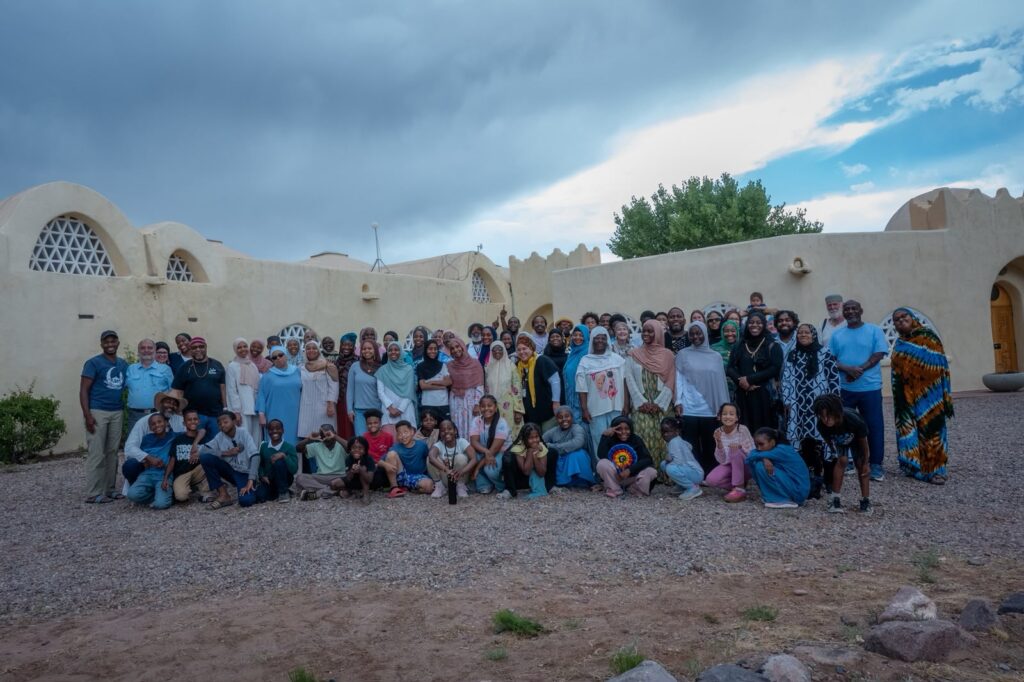
During some of our evening communal gatherings, we recited, chanted and sang familiar litanies of dhikr and praise of the Prophet ﷺ right alongside songs like Lift Every Voice and Sing and devotional songs written by members of the community. All of it carried the familiar sounds of Black American musical tradition, without any need to resolve a tension between these things because there wasn’t one. We were Muslim and we were Black, and those identities were woven together like two strands of DNA. This retreat invited us to see ourselves as a distinct people among the many peoples that make up the Ummah of Muhammad ﷺ and to celebrate that.
The people who made up this village were not people I actually knew, but they felt like people I could have known all my life, and that led to a feeling of connectedness that I hadn’t expected, but felt deeply. Not in an obvious “I now have a collection of new friends I speak to every day” kind of way, but something more subtle— the knowledge that if I find myself sitting across the table from them again next year, we will simply pull up our chairs and pick up where we left off.
On one of our final days, as we reflected on our individual and collective experiences of the retreat—the people; the worship; the khidma; the food; the sounds; the conversations; the shared history; the intentionality with which all of it had been brought together—I realized it wasn’t a particular talk, a particular class, or a particular speaker that instilled in me a sense of belonging. It was the feeling of having arrived at a family reunion for the first time, being welcomed with open arms as though expected, and told, “Honey, grab a plate and pull up a chair.”
So what does someone arriving without family do at a family retreat? She walks in and discovers that she belongs.


http://www.Haalproject.org