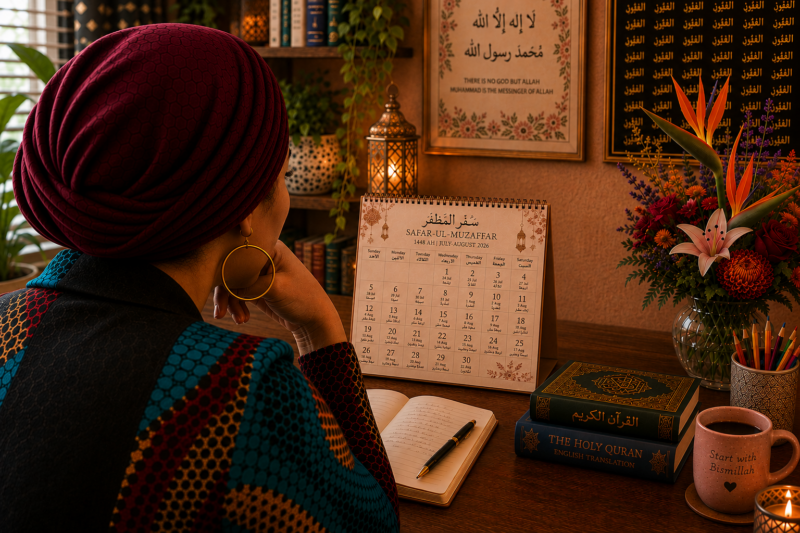
There is a little girl inside me who will always know the Gregorian calendar by heart. Her name is Leslie Ann.
She learned January through December so early that those months became almost like skin. She doesn’t have to remember what comes after August or where March belongs in the year. She simply knows. The Gregorian calendar became part of the way she learned to locate herself in time.
Decades later, Akanke—the Muslim woman Leslie grew up to become—is learning to orient herself more intentionally within the Islamic calendar.
Of course, the Islamic calendar and the months aren’t new to me. I became Muslim in 1994, when I was 31. I read extensively about my deen over the years, and after moving to the Middle East, I spent a summer in Jordan in 2008 in an intensive Islamic studies program studying sīrah, Arabic, and fiqh. I have been learning about Islam, alhamdulillah, throughout my life as a Muslim and will always enjoy learning more. It is a never-ending quest.
How could I live a Muslim life without knowing Ramadan? I certainly know Muharram. Rabiʿ al-Awwal became familiar through the conversations and observances surrounding our beloved Prophet Muhammad, peace and blessings be upon him. Other months were familiar by name or association.
But familiarity is not the same as orientation.
Ask little Leslie what comes after August, and she doesn’t even have to think. Ask Akanke to give you all twelve Hijri months in order—and, well, give your sister a minute.
I’m still learning.
Over the past year or so, however, I’ve had a reason to pay closer attention. We began organizing MANA’s newsletter according to the Islamic calendar rather than the Gregorian calendar, and I strongly feel that aligning each issue with an Islamic month is a great way to give our readers something meaningful about that month. Is it sacred? Is there some particular significance attached to it in the Qur’an or authentic Sunnah? What happened during it historically? Are there misconceptions about it? What can it teach us?
At first, those were editorial questions. We needed content for the newsletter. But somewhere along the way, the calendar itself began teaching me. Alhamdulillah. Organizing our work around the Islamic calendar has given me a reason to slow down, look more carefully, and become more intentional about the rhythm of the Hijri year.
And this month, Safar caught me paying attention.
What Is Special About Safar?
That was one of the thoughts I began with. Safar is the second month of the Islamic calendar, immediately following Muharram, which marks the beginning of the new Hijri year. The Hijri calendar takes as its historical starting point the year in which Prophet Muhammad, peace and blessings be upon him, migrated from Makkah to Madinah. But as I looked more closely at Safar, I realized that I first needed to reconsider my question.
Not every Islamic month is a sacred month. Allah tells us, “Indeed, the number of months ordained by Allah is twelve…of which four are sacred” (Qur’an 9:36). The Prophet Muhammad, peace and blessings be upon him, identified those four as Dhul-Qaʿdah, Dhul-Hijjah, Muharram, and Rajab.
Safar isn’t one of them.
That doesn’t mean Safar is meaningless. It means I am learning to distinguish between different kinds of significance. A month may have a sacred status established by Allah. Particular acts of worship or virtues may be associated with another period. A month may hold important events in Muslim history. And sometimes a month is simply one of the twelve months through which Allah allows our lives to unfold.
That realization gave me a better question: Instead of beginning with, “What are Muslims supposed to make special about this month?” I want to begin with, “What have Allah and His Messenger, peace and blessings be upon him, actually taught us about it?”
Safar gave me an interesting answer.
Safar and the Things We Give Power
Historically, various beliefs and superstitions became associated with Safar. In an authentic hadith narrated by Abu Hurairah, the Prophet, peace and blessings be upon him, rejected several pre-Islamic superstitions — including tiyarah (belief in evil omens) and the belief that the month of Safar itself brought misfortune. Scholars have discussed the precise meaning of the reference to Safar in this hadith and the particular belief being rejected, so I don’t want to claim more than the sources allow.
What is clear, however, is that the Prophet, peace and blessings be upon him, rejected superstition and taught us not to treat any created thing—a month, a date, an omen, or a circumstance—as though it can govern our destiny apart from Allah. A month does not control our destiny. A date cannot decree our future. An omen cannot overrule Allah. Allah is in control of all things.
The more I thought about that, the less Safar seemed like an obscure lesson about beliefs held in pre-Islamic Arabia. Human beings still give enormous power to things Allah has not made sovereign over us. We give power to predictions, circumstances, other people’s opinions, cultural assumptions, and sometimes even our own fears about what the future must hold.
As an African American Muslim woman, I can’t help but hear something else that resonates in that lesson. Our people have lived through centuries in which others made pronouncements about who we were, what we were capable of, where we belonged, what we deserved, and what kind of future we could have. Those pronouncements had devastating real-world consequences, including the internalization of messages that were never meant to define us, and we should never minimize their effects. But Islam also teaches us that human beings do not possess Allah’s authority over our ultimate worth or destiny. This knowledge can help heal and free us mentally, spiritually, and emotionally from definitions of ourselves that were never ours to carry.
Safar reminded me of something worth remembering: Be careful who and what you give power.
What We Learn as Children
A while ago, in a conversation with our president, Joshua, I learned something that made me smile. He knows the Islamic months by heart because he learned them through a melody as a child attending Islamic schools.
That stayed with me because the Islamic months became familiar to Joshua through repetition, environment, and song, much the way January through December became second nature to little Leslie. I wasn’t discouraged by that realization. I was fascinated by it because it made me think about formation. What do children absorb simply because we surround them with it? What Islamic knowledge, such as learning the meaning of the 99 attributes of Allah, can become so ordinary in the lives of our children that, when they are adults, they cannot even remember having to learn it?
There is something especially meaningful about that question for African American Muslim families and institutions. Our paths into Islam have not all been the same. Some of us entered Islam as adults. Some were born into Muslim families. Some attended Islamic schools, while others learned through parents, masajid, halaqahs, books, teachers, community institutions, travel, marriage, or simply years of living with the deen.
There isn’t just one pathway to Islamic knowledge for African American Muslims or any Muslim. But whatever road brought us here, we have an opportunity to think intentionally about what we pass forward. What can we place so naturally into the lives of our children that the Islamic calendar, Muslim history, Qur’anic knowledge, the attributes of Allah, Most High, and knowledge of the Prophet, peace and blessings be upon him, become part of the landscape of childhood?
Joshua’s little melody about the Islamic months suddenly doesn’t seem so little.
Finding Ourselves in the Story
Perhaps this is also why the historical dimension of the Islamic calendar is beginning to affect me so deeply. African American historical memory carries profound ruptures. The transatlantic slave trade severed people from families, names, languages, homelands, cultures, and religious traditions. Yet among the Africans enslaved and transported to the Americas were Muslims who struggled under extraordinary circumstances to retain elements of their faith, literacy, identity, and community.
Some of their names and writings survive. Omar ibn Sayyid left Arabic manuscripts. We have the remarkable story of Ayuba Suleiman Diallo. We know of Bilali Muhammad and other African Muslims whose lives left evidence of Islamic belief, Arabic literacy, Qur’anic knowledge, and efforts to maintain religious identity under enslavement.
We need to approach that history carefully. Not every enslaved African was Muslim, and African American Muslims today do not share a single ancestral or religious lineage. But the historical record allows us to say something important without exaggeration: Islam is part of African American history, and African American Muslims are part of the history of Islam in America. Allah has allowed Islam to reach us, here in America, through many pathways. He is indeed Most Kind, Most Generous, The Guide.
Becoming more attentive to the rhythm of the Hijri year doesn’t require me to abandon the calendar little Leslie learned or the history that formed her. I don’t have to exchange my African American history for an Islamic history. I have learned to locate myself more deeply within both. Understanding both helps me better understand who I am, what I have inherited, and what I am responsible for passing forward.
Still Paying Attention
I’m 63 years old now, and little Leslie still knows January through December without giving it a second thought. I don’t think Akanke needs to take that away from her. But Akanke is paying closer attention now. Muharram. Safar. Rabiʿ al-Awwal. Rabiʿ al-Thani—and, hold on now, give your sister a minute!
I’m still learning. :)
Allah instructed His Messenger, peace and blessings be upon him, to pray, “My Lord, increase me in knowledge” (Qur’an 20:114). Rabbi zidni ʿilma. There is no age limit on that duʿa, and there is no point at which we have been Muslim long enough to exhaust what the deen can teach us.
Sometimes knowledge comes through a scholar or a classroom. Sometimes through a book. Sometimes, through a melody learned in Islamic school. And sometimes, alhamdulillah, Allah gives you a newsletter to put out every month and causes you to look more closely at something that has been in front of you for years.
So, insha’Allah, I’m going to keep paying attention. As each Islamic month comes around, I want to look more deeply: What has Allah actually made sacred? What did our Prophet, peace and blessings be upon him, teach us? What happened in Muslim history? What do we know with certainty, and where should we be careful about what we claim? And, where appropriate, what might the particular history and experience of African American Muslims help us see?
Safar didn’t introduce me to the Islamic calendar. It caught me paying attention.
And now Rabiʿ al-Awwal is coming. We’ll talk about that next time, insha’Allah.
What might we discover about our deen, our history, our community, and even ourselves if we begin paying closer attention to the rhythm of the Hijri year?
Dua: Ya Allah, Al-ʿAlīm, the All-Knowing, increase us in beneficial knowledge. Let what we learn draw us nearer to You, deepen our love for Your Messenger, peace and blessings be upon him, strengthen our families and our community, and help us preserve and pass forward what is good. Ameen.

Akanke is a communications specialist and consultant with a degree in Communication from Georgia State University, focused on film, TV, and cultural anthropology. Her career is diverse, and her interests span various creative forms of expression — from producing TV and radio shows to creating documentaries, writing, graphic design, and life coaching, she strives to make a lasting and authentic impact wherever she goes. She reverted to Islam in 1994 and is passionate about Islam and Islamic spirituality, a passion that runs through nearly every corner of her work. Akanke has been a dedicated supporter of the Muslim Alliance in North America (MANA) since 2007, currently serving as the organization’s Board Vice President — working alongside the Board President and Secretary to help shape MANA’s trajectory — and previously served for several years as its Communications Director. A native of Atlanta, she now resides in Dayton, Ohio.


2 Responses
As Salaamu Alaikum. Alhamdulillah. An excellent article. Thank you.
MashaAllah, alhamdulillah, you’re welcome.