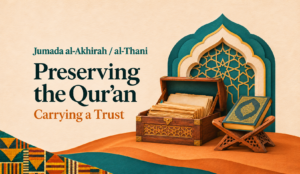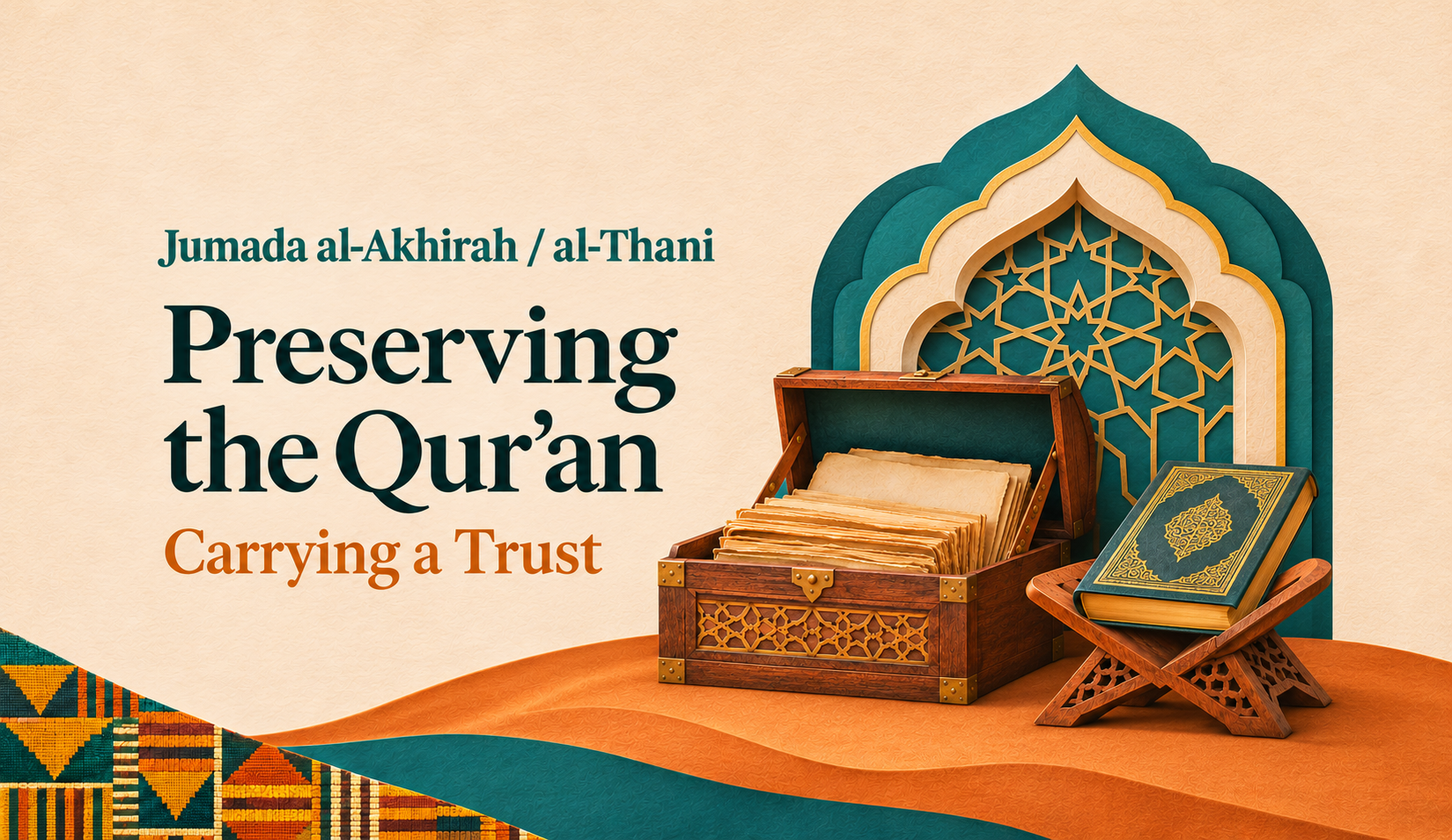
As I continue studying and embracing the Islamic calendar, I am finding connections that invite me to look more closely at our history. This month, Jumada al-Akhirah led me to revisit the life of Abu Bakr al-Siddiq, may Allah be pleased with him, and his role in gathering the Qur’an.
Jumada al-Akhirah, also called Jumada al-Thani, is the sixth month of the Islamic year, the latter of the two Jumada months. It carries no prescribed worship unique to it. Among its historical associations is the passing of Abu Bakr in 13 AH. Learning about his passing drew my attention to an undertaking during his caliphate that continues to benefit Muslims today and will benefit generations to come.
Recognizing a Responsibility
In Sahih al-Bukhari, Zayd ibn Thabit recounts that Umar became concerned after many reciters of the Qur’an were killed at Yamamah. He urged Abu Bakr to commission a collection of the Qur’an.
Abu Bakr initially hesitated because Prophet Muhammad, peace and blessings be upon him, had not undertaken that particular task. After discussion, he accepted its benefit and entrusted Zayd, who had served as a scribe of revelation, with the work.
Zayd gathered material from written sources and those who had memorized the Qur’an. The resulting manuscripts remained with Abu Bakr, then Umar, and afterward Hafsah bint Umar, a wife of the Prophet, peace and blessings be upon him. (Sahih al-Bukhari, 4986)
Hafsah: Entrusted with the Manuscripts
Hafsah’s role deserves attention. She safeguarded these manuscripts, and when Caliph Uthman later commissioned copies of the Qur’an for distribution, he requested them from her for that work and afterward returned them. Her custody places a woman—a Mother of the Believers—within this important history of preserving and transmitting the Qur’an. (Sahih al-Bukhari, 4987)
What stays with me is the care each person gave to the responsibility entrusted to them. Umar recognized a concern. Abu Bakr considered it and authorized the work. Zayd undertook the collection. Hafsah safeguarded the manuscripts that would later support Uthman’s effort to prepare copies for the wider Muslim community.
Learning about their contributions deepens my gratitude for the Qur’an we can open, read, memorize, and learn from today. It also invites a personal question: how much care am I giving to my own relationship with this revelation?
Dua: O Allah, reward those who preserved Your Book. Open our hearts to its guidance, deepen our understanding, and help us embody its teachings in our lives. Ameen.

Akanke is a communications specialist and consultant with a degree in Communication from Georgia State University, focused on film, TV, and cultural anthropology. Her career is diverse, and her interests span various creative forms of expression — from producing TV and radio shows to creating documentaries, writing, graphic design, and life coaching, she strives to make a lasting and authentic impact wherever she goes. She reverted to Islam in 1994 and is passionate about Islam and Islamic spirituality, a passion that runs through nearly every corner of her work. Akanke has been a dedicated supporter of the Muslim Alliance in North America (MANA) since 2007, currently serving as the organization’s Board Vice President — working alongside the Board President and Secretary to help shape MANA’s trajectory — and previously served for several years as its Communications Director. A native of Atlanta, she now resides in Dayton, Ohio.